

Gendered Justice and Constitutional Symbolism: The Historical Appointment of Martha Koome as Kenya’s Chief Justice
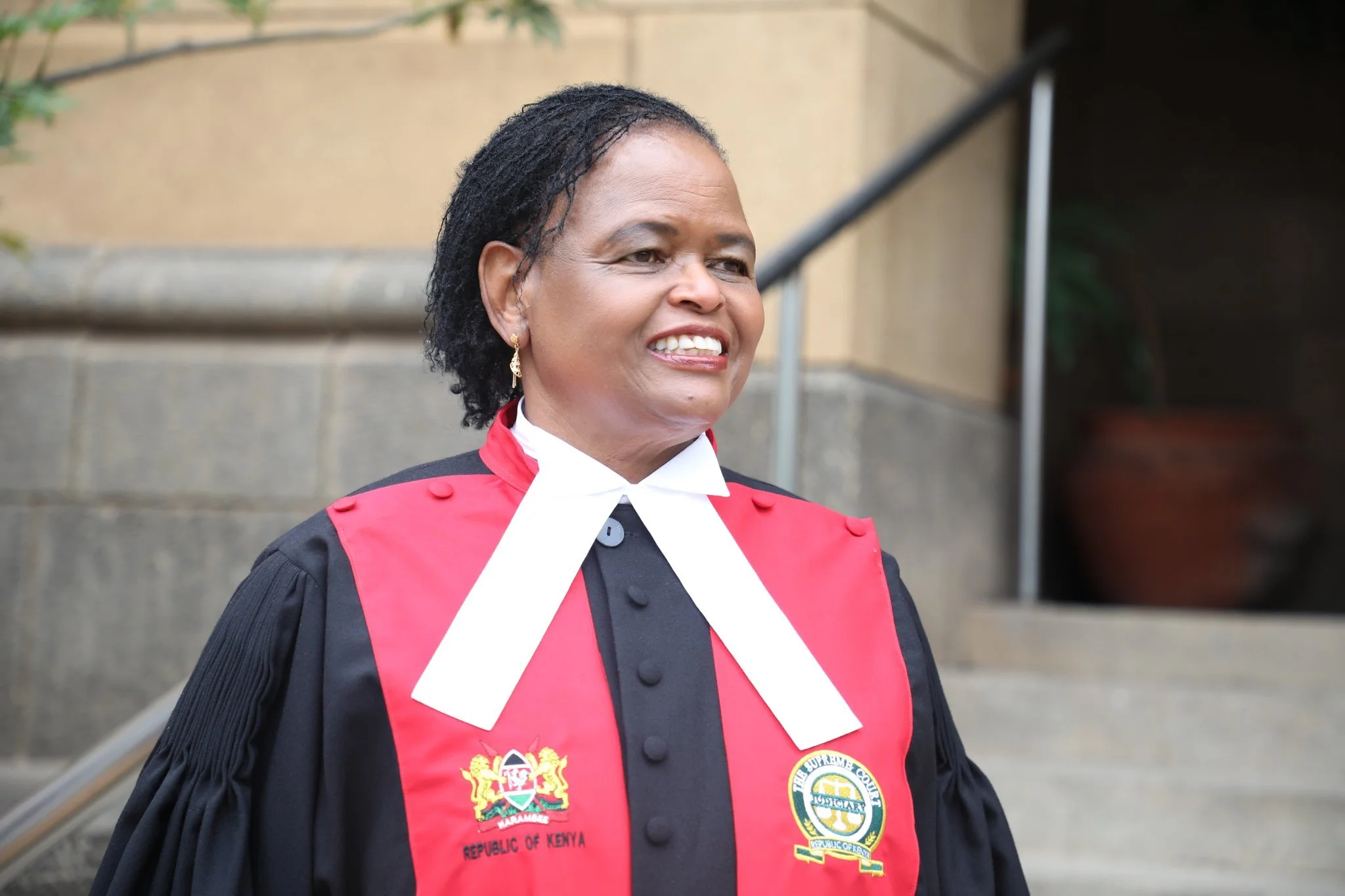
"Martha Koome" by Cmwaura is licensed under CC BY-SA 4.0.
In May 2021, Kenya broke the judicial ceiling with the appointment of Honourable Martha Koome as its first woman Chief Justice.
Before her appointment, the upper ranks of the judiciary were overwhelmingly dominated by men, reinforcing its patriarchal character, one that relegated women to the kitchen of the institution while reserving the sitting room of the institution, that is, the public authority, for men. Koome’s appointment, therefore, was significant and signalled a powerful moment of constitutional symbolism, a constitutional commitment to gender equality.
It took 53 years for Kenya to appoint its first woman Chief Justice, and in many ways, Koome walked out of the institutional kitchen, signalling what is possible not only for Kenya but for Africa more broadly. In her recently launched autobiography, Koome describes this 53-year journey more eloquently, noting that the wall outside the Chief Justice’s office features photos of her predecessors, and hers is the only image of a woman. She notes that, “it is a lonely image; the only portrait of a woman on this wall of men. My photo disrupts this wall of patriarchy as the 16th Chief Justice of Kenya since independence. It is a major score for equality and women.”
What Koome says is that her lonely portrait signifies a disruption. It speaks to the breaking of patriarchy’s continuity (not only its visual continuity). This is, therefore, a significant victory for equality. While it may not be a conclusive triumph, we should not, for a moment, downplay the historical struggle against what we might call the REDS: institutionalised patriarchy and the institutional gatekeepers.
Gendered justice and why the appointment matters
In colonial and post-colonial states, women were bypassed in the arena of politics and public appointments, and the basis for this systemic exclusion, as Oyěwùmí reminds us, was because of their biology. They were simply categorised as ‘women’ and rendered ineligible for leadership. This was not only about the political leadership but also included judicial leadership. Whereas women struggled to join the profession, they were allowed to do so, but that was where it ended.
Dawun makes a strong point when she suggests that in the profession, there exists two ceilings: a glass and a concrete ceiling. Joining the profession was a glass ceiling which was easy to shatter. The secondary ceiling – joining the leadership – was, however, a concrete ceilingrequiring women to fight harder to break. As such, across Africa, fewer women have joined the upper echelons of the judiciary. However, the project of transformative constitutionalism (the new spreading burning bush in the block) seeks to overturn the colonial and postcolonial legal mindset that has led to an unequal society in which certain perspectives are excluded. Such perspectives include the voice of women in adjudication.
The project of transformative constitutionalism and its sister, transformative adjudication, appreciates that there must be a ‘transformation of gendered structures, hierarchies, and relationships’, including jurisprudence and therefore leading to gendered justice. This calls for judges to be contextually aware of what is demanded of them. For instance, Justice Sachs noted that:
“Certainly, all the judges on the Constitutional Court recognised the need for major transformations in society, not only the ugliness and unfairness and injustice of apartheid dreadfulness, but the fact that it had left quite deeply entrenched patterns of inequality and disparity.”
As such, diversity in the judiciary’s leadership and even the bench plays an important role in confronting deeply entrenched patterns of inequality. The appointment of women to leadership roles in the judiciary brings to the fore the ‘gendered’ voice and seeks to end the pattern of exclusion granting the judiciary legitimacy. Second, it brings to the bench perspectives that were previously absent. One of the most evident parts of such voices is the difference between formal and substantive equality in jurisprudence. The previously excluded voice can bring out the disparate impact of seemingly neutral rules. On whether the appointment of Koome’s has had a real impact, this is a subject for another post.
“A genuine commitment to equality is demonstrated when women are allowed to occupy the highest positions and visibly disrupt the walls of patriarchy that have long defined the judiciary.”
Historical constitutional journey and Martha Koome
Kenya’s constitutional historical journey was marked by various subjects, but one of the key aspects was putting to an end the idea that the laws and institutions then were sites of women’s oppression. The struggle for the 2010 Constitution was meant to reverse this unfortunate history. Women’s movements and women, including Martha Koome, played a central role in this fight. Martha Koome started her career as an advocate, representing clients in court, with a bias toward women fighting against unjust laws and systems. She then assumed leadership roles at the Law Society of Kenya, where she advocated for a just Kenya and represented political detainees. She would then head the Federation of Women Lawyers in Kenya, a women’s organisation where, with others, she fiercely fought for women and children’s rights. It is these roles that finally brought her to the constitution-making table. Although she joined the judiciary before the 2010 Constitution was born, she had laid the groundwork.
Before her, however, there were trailblazers, including the Lady Justices Effie Owuor and Joyce Aluoch. Yet history shows that women judges were largely concentrated at the lower levels of the judiciary: the Magistracy and the High Court. The first woman was appointed to the High Court in 1993, nearly 30 years after independence. At one point, there was not a single woman on the Court of Appeal, then the highest court in the land. It was, quite simply, a manel. The first woman was not appointed to the Court of Appeal until 2003. Martha Koome’s appointment must therefore be understood against this historical backdrop. This history exposes a judiciary structured to exclude women from real power. Koome’s appointment must therefore be read not as an isolated milestone, but as a rupture in a long-standing architecture of exclusion.
Lessons beyond Kenya
Koome’s appointment as the first Woman chief justice set a standard for Africa. The Appointment of Koome was quickly followed by the appointment of Chief Justice Rehana Mungly-Gulbul of Mauritius in November 2021. In 2024, South Africa’s president Ramaphosa appointed Mandisa Maya as the first woman chief justice. Notably, the president had bypassed Maya in 2022, making her appointment a historical moment. Similarly, Nigeria appointed Chief Justice Kudirat Kekere-Ekun, and recently, Rwanda appointed Chief Justice Domitilla Mukantaganzwa.
Koome’s appointment should therefore be seen as a sign of hope that continues to inspire women across the continent. Although the ceiling is concrete, it is breakable, and cracks are visible. However, this hopeful message must also be contextualised with two caveats. First, breaking this concrete ceiling cannot be an individual effort but requires collective efforts, because ‘each stakeholder playing their part will create the village needed to advance women’s leadership in the legal profession’. Second, those recruiting must stop posing the wrong question, as the one posed to Maya on whether a country is ready for a female chief justice or judge. Recruiters need to move beyond that patriarchal gatekeeping role where the competence of a woman judge is tied to her gender, and the male candidates are never asked that question. As Maphosa notes, such a line of questioning is absurd, and I think it reinforces the point above that women in the past were seen as unfit to lead on account of their gender alone.
Conclusion
Martha Koome’s appointment brings to an end the patriarchal coalition between laws and institutions. It signifies Kenya’s first serious attempt to achieve gender parity in judicial leadership and to confront what has now been described as the deputy syndrome within the judiciary’s leadership. By this, I mean the practice of appointing women as deputies to give institutions the veneer of equality: when men hold the top positions, women are quickly assigned subordinate roles. On the surface, the institution appears gendered, but in reality, it remains patriarchal.
The lesson from this is that a commitment to equality cannot be achieved by merely deploying the deputy syndrome in the judiciary. A genuine commitment to equality is demonstrated when women are allowed to occupy the highest positions and visibly disrupt the walls of patriarchy that have long defined the judiciary. Kenya’s appointment of Chief Justice Martha Koome did that and signalled a deep commitment to the realisation of equality.