
Book Feature: Handbook on Human Rights to a Healthy Environment International, Regional, and Comparative Pathways for Policy Intervention in Cameroon (2026), edited by Jean‑Claude N. Ashukem.
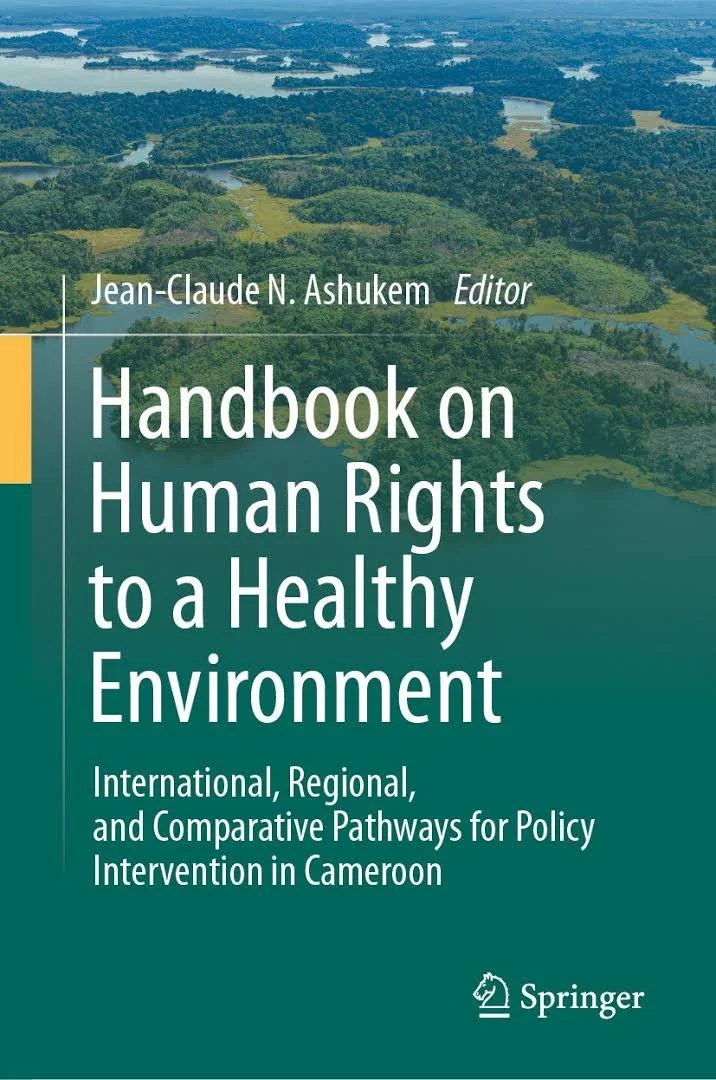
Editor’s note: African Law Matters Features Handbook on Human Rights to a Healthy Environment: International, Regional, and Comparative Pathways for Policy Intervention in Cameroon, an important new contribution to the growing body of scholarship examining the intersection of human rights and environmental protection in Africa. Edited by Dr. Jean-Claude N. Ashukem, the volume brings together international, regional, and comparative perspectives to explore how the right to a healthy environment can be translated from legal principle into practical governance and policy action. While it has a particular focus on Cameroon, the book offers insights that resonate across the continent, engaging urgent debates on sustainable development, environmental justice, and the role of law in responding to ecological challenges.
Your edited volume arrives at a time when there is growing recognition of environmental rights globally. What inspired the focus on Cameroon as a case study, and how does it speak to broader African environmental governance challenges?
Answer: Cameroon is often described as ‘Africa in miniature’ and, for this reason, faces numerous environmental and human rights violations. These violations, together with widespread waste pollution and the weak regulation of development projects, challenge the constitutional foundations of the country’s environmental framework. As a human rights and environmental analyst, researcher, and academic, I was deeply touched by these issues and thought of addressing them through this edited volume.
The book is also motivated by the relative scarcity of scholarship on environmental rights in Cameroon. To date, no book has interrogated the constitutional foundation of environmental rights and their relevance to diverse environmental interests, as this volume does. While grounded in the Cameroonian context, the book engages an array of environmental issues across different African jurisdictions. In doing so, it proposes feasible legal and policy measures relevant to addressing broader environmental governance challenges on the continent.
As editor, you brought together international, regional, and comparative perspectives. How do these different legal layers interact in shaping the realisation of the right to a healthy environment in African states?
Answer: Environmental problems are not confined to a single jurisdiction; they are global in nature and affect all nations. It is therefore necessary to investigate and understand the interplay of international, regional, and comparative perspectives in addressing these problems.
The perspectives examined in the book provide an ongoing framework for understanding rapidly evolving trends in environmental governance. They also enable an assessment of whether international, regional, and comparative regulatory measures are adequate to protect the environment and strengthen the right to a healthy environment. Importantly, they allow us to evaluate how domestic legal regimes align with international developments and standards.
The right to a healthy environment is increasingly framed as both a constitutional and a human rights issue. In your view, what are the most significant legal and institutional barriers to its effective implementation across Africa?
Answer: One of the legal barriers is the lack of political will to enforce domestic, international, and regional commitments, as well as to enact and implement robust environmental legislation. There is also the persistent challenge of balancing environmental rights with development interests.
Institutionally, a combination of judicial, administrative, and economic factors hinders the translation of theoretical rights into practical protection. Quite often, courts struggle to enforce orders against state or private actors, and few African jurisdictions have specialised environmental courts or adequately trained environmental judges.
Furthermore, the issue of locus standi presents an additional challenge. In Cameroon, for example, courts have interpreted standing strictly, limiting it to registered entities with a recognised environmental interest, rather than extending it to any individual or group whose rights or interests are affected. This requirement to prove direct injury, combined with the difficulty of establishing causation in complex and long-term environmental degradation, creates significant obstacles for public interest litigation.
On the administrative side, the broad and cross-cutting nature of environmental governance means that responsibility is often dispersed across different government departments, such as water, mining, health, and forestry, among others. This fragmentation often leads to incoherent policy, duplication of mandates, conflicting goals, poor coordination and implementation of environmental laws, and a general lack of accountability. The problem is particularly pronounced in many African jurisdictions. South Africa has sought to mitigate these challenges by creating a “one-environment” approach aimed at streamlining environmental authorisation processes and strengthening coordination and compliance with relevant environmental laws.
The handbook highlights policy pathways alongside legal analysis. What practical lessons can policymakers and lawmakers draw from the Cameroonian experience when designing environmental protection frameworks?
Answer: The lessons are reciprocal; no legal system has a viable approach. There is always a need to learn from different legal systems and approaches, as demonstrated in the book.
A key lesson is the importance of enforcement. The law must be effectively implemented to achieve its intended purpose. Cameroon tends to enact incomplete laws, restricted to the enactment of a presidential decree, which is often not enacted. Furthermore, constitutional environmental rights framing should be unambiguous and indicate a clear role and responsibility of environmental authorities, especially the state.
Many African jurisdictions face tensions between natural-resource exploitation and environmental protection. How can a rights-based approach help reconcile development priorities with ecological sustainability?
Answer: A rights-based approach is crucial to ensuring environmental protection. It could help reconcile development priorities with ecological sustainability by shifting how we view natural resources not merely as economic commodities but as essential components of human dignity and survival.
Furthermore, the rights-based approach enhances governmental accountability for environmental harm and reinforces states’ human rights obligations.
Such an approach enhances governmental accountability for environmental harm and reinforces states’ human rights obligations. It encourages caution in the face of ecological degradation and requires consistency in implementing relevant legal provisions. Ultimately, a careful balance must be struck when assessing development projects and their potential implications for environmental rights.
The book adopts a comparative outlook. Which jurisdictions or legal developments within or beyond Africa offer the most promising models for strengthening environmental rights enforcement?
Answer: South Africa. But gaps exist in some respects. Hence, the need to learn from each other's experiences is crucial. For example, the Environmental Court experience in Uganda and Kenya could be relevant to South Africa. At the same time, South Africa’s constitutional environmental framework has influenced constitutional developments in Zimbabwe and Kenya, illustrating the cross-fertilisation of environmental rights norms across the continent.
Finally, what role should courts, civil society, and regional bodies play in advancing environmental justice, and how do you see the discourse on the right to a healthy environment evolving in Africa over the next decade?
Answer: Courts and regional bodies such as the African Commission on Human and Peoples’ Rights (ACHPR), the Southern African Development Community Tribunal (SADC) tribunal, the East African Court of Justice (EACJ), etc., should use their interpretative authority to develop environmental law jurisprudence consistent with constitutional environmental visions.
Civil society should play a strong advocacy role, capacity-building initiatives, and public environmental awareness.
In terms of the future evolution of the African environmental rights landscape, there is positive progress. Some jurisdictions have enshrined the right to nature in their legal frameworks, and others have enacted climate change laws to address climate change concerns. It is hoped that more countries will follow these trends, drawing lessons from emerging models to strengthen African environmental governance over the next decade.