
Human Dignity has no nationality: Xenophobia, Constitutionalism and the Struggle for Justice in South Africa
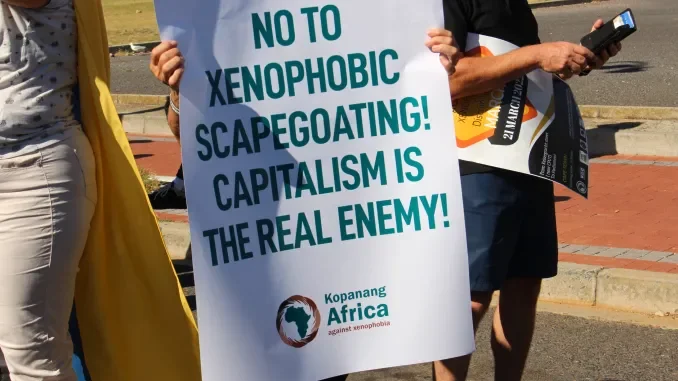
Picture Credit: https:https://kaax.org.za/
Across South Africa, migrants and asylum seekers continue to face violence, exclusion, harassment and public humiliation. Vigilante formations increasingly position themselves as defenders of communities while political rhetoric normalises the idea that Black African migrants are responsible for unemployment, crime and the collapse of public services.
More than 30 years into democracy, South Africa faces a profound question - does human dignity belong to everyone who lives in this country, or only to those recognised as citizens?
Thirty years into South Africa’s constitutional democracy, the promise of transformation remains both foundational and contested. The Constitutional Court has described the Constitution as a commitment to transform society, a principle that lies at the heart of the new constitutional order.
This fundamental philosophy is expressed in the epilogue to the Interim Constitution which acknowledges the severe human rights abuses and divisions of the past, yet calls for a response grounded in understanding, reparation, and ubuntu, rather than retaliation, victimisation, or vengeance.
The Constitution is the supreme law of South Africa and at its core, it is a transformative document aimed at redressing historical injustice and building a society founded on dignity, equality and freedom.
The former Deputy Chief Justice Dikgang Moseneke made reference to the Constitution as a "post-conflict" document: "At its core, our Constitution is transformative. It's not a constitution that was meant to preserve the status quo”.
In recent months the courts have handed down judgments on acts of vigilantism in South Africa upholding the values and ethos of our constitution, respect for human rights and respect for dignity for all who live in South Africa.
Towards the end of 2025 the Johannesburg High Court handed down judgment in the matters of Kopanang Africa Against Xenophobia vs Operation Dudula- and - Treatment Action Campaign and Others v Facility Manager, Yeoville Clinic and Others which are both a good demonstration of how the exercise of both public and private power is constrained by the Constitution.
In the matter of Kopanang Africa (KAAX) taking Operation Dudula to court, the application sought to stop Operation Dudula’s pattern of unlawful conduct, including intimidation, harassment, assault, and hate speech against non-nationals and those perceived to be foreign. The court’s judgment found that Operation Dudula’s vigilante conduct constitutes a clear violation of the rule of law, as no one is entitled to take the law into her or his own hands. The court granted a final interdict against Operation Dudula, holding that the rights to equality, human dignity, life, freedom, and security of the person of all individuals are being violated and threatened by their actions.
In the matter of the Treatment Action Campaign versus the Department of Health- there were two parts to this litigation. In the judgment handed down in Part A of the application, Wilson J found that the lack of action by state authorities charged with the constitutional mandate to protect the right to access to healthcare for all, including the City of Johannesburg Metropolitan Municipality, the National Department of Health, the Gauteng Department of Health and the South African Police Service violated the constitutional rights of patients seeking healthcare at the Yeoville and Rosettenville clinics by failing to prevent the obstruction of access to public health facilities.
In his opening comments judge Wilson pointed out that xenophobia is a serious threat to democracy and human rights, arguing that it is rooted in prejudice and often functions as a form of racism. He warned that blaming foreign nationals for social and economic problems misdirects public attention away from the structural causes of poverty, inequality, and violence, allowing these deeper issues to remain unaddressed.
The history of humanity is scarred by violence rooted in nationalism and ethnic division, intentionally created by historic and current unjust regimes of power. We exist in a context where, through social action, apartheid — a system of injustice — was overthrown.
Although we have not yet actualised a truly transformed society, this struggle has given us a framework. We must take action and work together to advance the agenda of our ancestors and those who historically led the struggle.
Historic examples of abuse of power
Witnessed on the African continent is the Rwandan genocide. The Hutu-led government abused its power to orchestrate the killing of an estimated 800,000 people solely because they belonged to the Tutsi minority group. This violence was invisibilised while neighbouring South Africa was hyper-visible in the media, with the inauguration of President Mandela and the fall of the apartheid regime in 1994.
On the European continent, the world can never forget the Holocaust under Nazi Germany. Power was abused to declare Jewish people as sub-human. This narrative was used to justify gross human rights violations. People of Jewish descent were killed, together with Romani people, people with disabilities, members of the LGBTQI+ community, and people who belonged to the Jehovah’s Witness faith. Estimates suggest that between 11 and 12 million people were killed. Anyone who did not conform to the Nazi ideal of a heterosexual person with blue eyes and blond hair was framed as the enemy responsible for Germany’s unemployment and social problems.
The world today
Contemporary global politics continues to reflect similar dynamics of exclusion, where migration, identity and nationality are used to justify violence, displacement and legal marginalisation. From conflict zones to immigration enforcement regimes, patterns of dehumanisation remain persistent across different political systems. Currently the world is witness to the genocide taking place in Gaza perpetrated by Israel against the people of Palestinian nationality. Alongside this, our siblings in the DRC, Sudan, and undocumented people living in white supremacist nations such as America continue to face lives marked by exclusion, violence, and trauma.
South African context
Today, more than 30 years into a democratic dispensation, we still suffer the injustices of the past. The divisions along race, class, and gender persist, and we now witness the weaponisation of nationalism.
In South Africa, we are familiar with this injustice because apartheid and colonialism still haunt our social and political landscape. We navigate a reality rampant with conflict and division on the lines of class, gender, nationality, belief and sexual orientation among many others. Simply driving to the grocery store on any given day makes this clear from the number of homeless people at traffic lights.
This danger presents itself in the current xenophobic violence and the rise of vigilantism in the form of Operation Dudula and March on March. The presence of Black African Migrants (as targeted by Action SA, Patriotic Alliance and the vigilante groupings), is not the cause of systemic unemployment, continued unliveable conditions of poverty and starvation in SA as these reactionary, counter revolutionary forces will have us believe.
It is a direct consequence of the neoliberal economic policies and austerity measures that result in a reduction in public spending in the form of a freeze on the hiring of health care workers, resulting in overcrowding and poor quality health care. The levels of unemployment have reached unliveable levels. Added to this is corruption and mismanagement at all levels of government.
The legacy of apartheid continues to shape access to healthcare in South Africa. The system was historically structured to privilege white populations while marginalising Black communities through spatial segregation, labour exploitation and unequal infrastructure development. The struggle for socio-economic rights including access to quality health care and education for all in South Africa and in the region follows the struggle against the long history of colonialism and apartheid.
Calls for justice in relation to socio-economic rights build towards actualising transformation and restorative justice. These are particularly relevant in the healthcare sector where we navigate a system which has been divided. Those with historic wealth and systematic privilege access dignity in the form of quality healthcare. Those who felt the brunt of unjust regimes of apartheid and colonialism generally remain in the margins.
Under colonialism, health services were designed to protect the white settler minority. Apartheid saw the fragmentation and racialisation of the health system, shaping the disease burden, mortality rates, and structural violence faced by Black people. Furthermore, overcrowding and poor sanitation in Black communities were normalised, alongside the super-exploitation of migrant labour, with people forced to live in hostels under inhumane conditions.
Today, communities occupying these same spaces continue to endure similar conditions, including inadequate access to electricity and water, as well as reliance on coal for daily survival. These conditions contribute to the TB pandemic, which is rooted in the structural inequalities and infrastructure established under apartheid. Health inequalities along racial, class, and gendered lines are neither incidental nor accidental.
What is clear through these examples is the abuse of power and the targeting of the marginalised and dispossessed.
A call to action
In South Africa, we must mobilise and organise in a united struggle for the redistribution of wealth, including demands for the state to implement a universal basic income grant and a wealth tax. Through a collective global effort to dismantle systems of globalised white supremacist fascism, it may become possible to build a world that presently lies beyond our imagination. Central to this struggle is a commitment to action, guided by the principles of human dignity and human rights.
We cannot remain passive while these injustices persist and while those around us continue to bear the burden of this harm. Equally concerning is the rhetoric advanced by politicians, including the ANC, which seeks to blame our Black African brothers and sisters from across the continent for the systemic failures confronting South Africa. [U1][SE2] It is incumbent upon all of us to take action. Through collective effort, we have the capacity to create meaningful change.
Human Dignity is about love and respect for each other as human beings. The divisions and falsehoods that many of us have internalised form part of a broader global project of white supremacy, and we must actively work to resist and avoid reproducing these systems and narratives. As Bell Hooks, noted, “When men and women punish each other for truth telling, we reinforce the notion that lies are better. To be loving we willingly hear the other’s truth, and most important, we affirm the value of truth telling. Lies may make people feel better, but they do not help them to know love.”
The use of these frameworks through solidarity can change the narrative. Be part of this change by joining us. Your voice matters, and through your presence we can create the change that you are entitled to experience. Let’s hold those in power accountable and join our comrades globally as we unite to fight for human rights, dignity, and a world free from discrimination, violence, and abuse. We all deserve a safe and healthy life in which we can reach our full human potential.