
South Africa Has Two “K-words” - But Only One Tests Our Commitment to Dignity
Picture Credit: https://kaax.org.za/citizens-first-march-and-march-fails-by-its-own-yardstick/
Say one “k-word” in South Africa and you will likely face swift public condemnation, outrage, and potentially legal consequences. Say the other and you may encounter little resistance at most.
That contradiction reveals something uncomfortable about South Africa’s approach to hate speech. It raises questions not merely about language, but about whose dignity we are prepared to defend.
Over time, South Africa has drawn a clear legal and moral line around one word: the racial slur “kaffir”. The use of the term has resulted in prosecutions, convictions and intense public scrutiny. Examples include Vicki Momberg, Kessie Nair and Adam Catzavelos. Society has reached a broad consensus that language which degrades and dehumanises people based on race has no place in a constitutional democracy.
The message has been clear: some forms of speech do more than offend. They undermine the dignity of those targeted and threaten the constitutional values upon which South Africa is founded.
But there is another “k-word” in South Africa.
It is spoken in taxis, workplaces, political discussions, neighbourhood conversations and across social media platforms. It is directed not at race, but at nationality. It is "kwerekwere" - or its variants, “makwerekwere” and “amakwerekwere.”
Unlike its racial counterpart, however, it continues to circulate with remarkable ease.
“Kwerekwere” is not a neutral description of foreign nationals. It reduces African immigrants to noise - to unintelligible speech, to foreignness, to otherness. It denotes not only an inability to speak local languages, but suggests that one is subhuman, an “inferior scum of humanity.” These people are the “undeserving outsiders”, whilst South Africans are the “deserving citizens.”
The term carries a deeper implication: that those it describes do not belong; that they are lesser; that they are expendable.South African scholarship on xenophobia has long highlighted this dynamic.
Anti-immigrant sentiment is not simply about difference. It is about hierarchy. Immigrants are often portrayed as competitors, burdens or threats, while citizens are framed as rightful claimants to opportunity and public resources.
The ANC Secretary-General, Fikile Mbalula, recently remarked that the use of the term “amakwerekwere” is comparable to the use of the racial slur "kaffir".
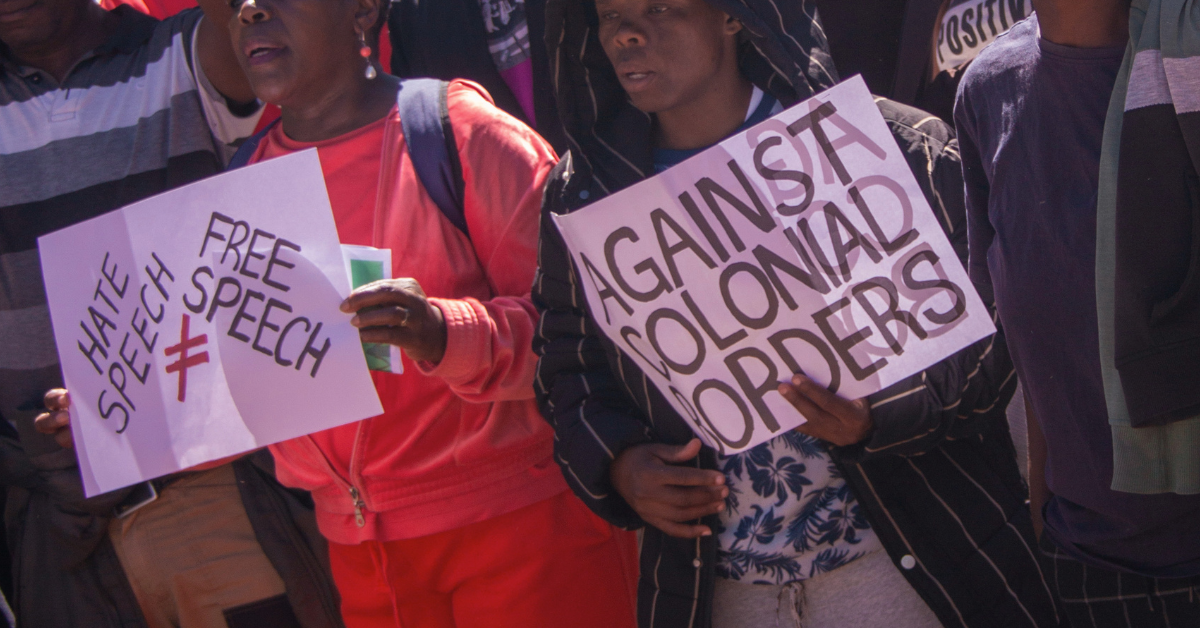
During the June 30 protests, Sunday World captured footage of protesters chanting, “voetsek, kwerekwere, voetsek” in Tshwane. The slogan illustrates how anti-immigrant rhetoric is expressed not only through political discourse but also through public acts of collective exclusion.
Language plays a critical role in sustaining this distinction.
This is why the Constitutional Court’s judgment in the case of Qwelane v South African Human Rights Commission is so important.
The case did not concern race. It concerned statements directed at members of the LGBTQ+ community. In upholding key provisions of S10 of the Promotion of Equality and Prevention of Unfair Discrimination Act 4 of 2000 (PEPUDA), the Court made clear that hate speech protections exist not merely to shield people from offence. They serve a broader constitutional purpose: protecting vulnerable groups from expression that promotes hatred and reinforces patterns of exclusion and marginalisation, while advancing equality, social cohesion and national unity.
The Court further recognised that speech directed at historically vulnerable minorities can deepen their exclusion from the political and social community. That insight is particularly relevant to migrants and refugees in South Africa. Like the LGBTQ+ community discussed in Qwelane, immigrants are frequently portrayed as outsiders, blamed for social and economic problems, and subjected to hostility that extends beyond mere disagreement or criticism. Their vulnerability is compounded by their limited political power. Non-citizen immigrants cannot vote and, therefore, lack one of the principal mechanisms through which interests are represented and protected in a democracy. This political marginality is one of the reasons courts have historically paid particular attention to the protection of vulnerable minorities.
Viewed through the framework established in Qwelane, the relevant question is not whether the term "kwerekwere" is merely offensive. Section 10 of PEPUDA targets expression that is harmful or incites harm and that promotes or propagates hatred against persons identified on prohibited grounds. When used to depict migrants as inferior, unwelcome or undeserving of protection, the term does more than communicate disapproval. It contributes to the stigmatisation of a vulnerable group, reinforces social exclusion and normalises hostility towards persons identified by their nationality or migration status. In a society that continues to grapple with xenophobic violence, anti-immigrant mobilisation, and the ejection of foreign nationals from public services, there is a strong argument that such expression implicates precisely the concerns that Section 10 was designed to address.
Immigrants and refugees occupy a vulnerable position in South African society. They are frequently blamed for unemployment, crime, housing shortages and pressure on public services, despite the absence of convincing evidence that they are responsible for these structural challenges. They are often the targets of hostility, discrimination and at times, violence.
Against this backdrop, it becomes difficult to dismiss “kwerekwere” as a harmless colloquialism. Recent events further illustrate why context matters. In Kopanang Africa Against Xenophobia and Others v Operation Dudula and Others, the courts were required to intervene after foreign nationals were prevented from accessing public facilities including schools and hospitals. Significantly, the court also prohibited Operation Dudula from publishing statements, including on social media, that constituted hate speech. The case demonstrates that xenophobic language does not exist in isolation. It can contribute to a broader environment of exclusion in which migrants are denied access to services, targeted for intimidation, or treated as less deserving of constitutional protection.
The Constitutional Court's contextual approach is important here. The meaning of words cannot be divorced from the circumstances in which they are used. In a context marked by recurrent xenophobic violence, displacement and intimidation, language that portrays migrants as outsiders or lesser human beings is capable of doing more than causing offence. It can reinforce patterns of prejudice and exclusion that make discrimination and violence easier to justify.
Words do not exist in isolation. They derive meaning from context. In a country that has experienced repeated outbreaks of xenophobic violence, from 2008 to 2015 then again in 2019, as well as in 2022 and amid the current anti-immigrant climate, the language used to mark immigrants as inferior or illegitimate carries particular significance.
The issue is, therefore, not whether every utterance of the word automatically constitutes hate speech. Context will always matter. The Constitutional Court made this clear.
The more important question is whether South Africa is applying its own constitutional principles consistently.
As interpreted by the Constitutional Court in Qwelane, Section 10 prohibits expression that is harmful or incites harm and that promotes or propagates hatred against persons identified on prohibited grounds. The provision reflects a constitutional commitment not only to dignity and equality, but also to social cohesion and national unity. The Prevention and Combating of Hate Crimes and Hate Speech Act 16 of 2023 similarly recognises nationality, immigrant status and refugee status as characteristics that can render individuals vulnerable to hate-based conduct.
In principle, the legal framework already acknowledges that xenophobia matters.
In practice, however, xenophobic language often occupies a curious grey zone. Expressions that would provoke immediate condemnation in one context are frequently tolerated in another. Language directed at immigrants is normalised in ways that would be unthinkable if directed at other vulnerable groups.
This inconsistency creates what can only be described as a hierarchy of dignity.
It suggests that some forms of dehumanisation deserve urgent attention, while others are treated as unfortunate but acceptable features of public discourse. It signals that some groups enjoy unconditional protection, while others must first prove that their humanity is worthy of recognition.
That should concern all South Africans.
The constitutional commitment to dignity was never intended to be selective. It was designed precisely to prevent the exclusion, stigmatisation and dehumanisation of vulnerable groups. In S v Makwanyane and Another, the Constitutional Court described dignity as a foundational constitutional value and emphasised that every person possesses inherent worth simply by virtue of being human. If dignity is truly foundational to South Africa's democracy, then it cannot depend on race, nationality, citizenship or immigration status.
South Africa has already shown a willingness to confront language that carries the weight of historical injustice. The challenge is whether it is prepared to do so consistently.
Ultimately, the issue is not whether South Africa has two "k-words", but whether we are prepared to apply constitutional principles consistently. If language directed at one vulnerable group warrants condemnation because it promotes exclusion, dehumanisation and hatred, then the same concern should arise when similar language is directed at another.
Until then, South Africa will continue to send a troubling message: that some forms of dehumanisation are unacceptable, while others remain tolerated.