
Two Kinds of Coups: A Constitutional Law Reading of Francophone Africa’s Military Takeovers
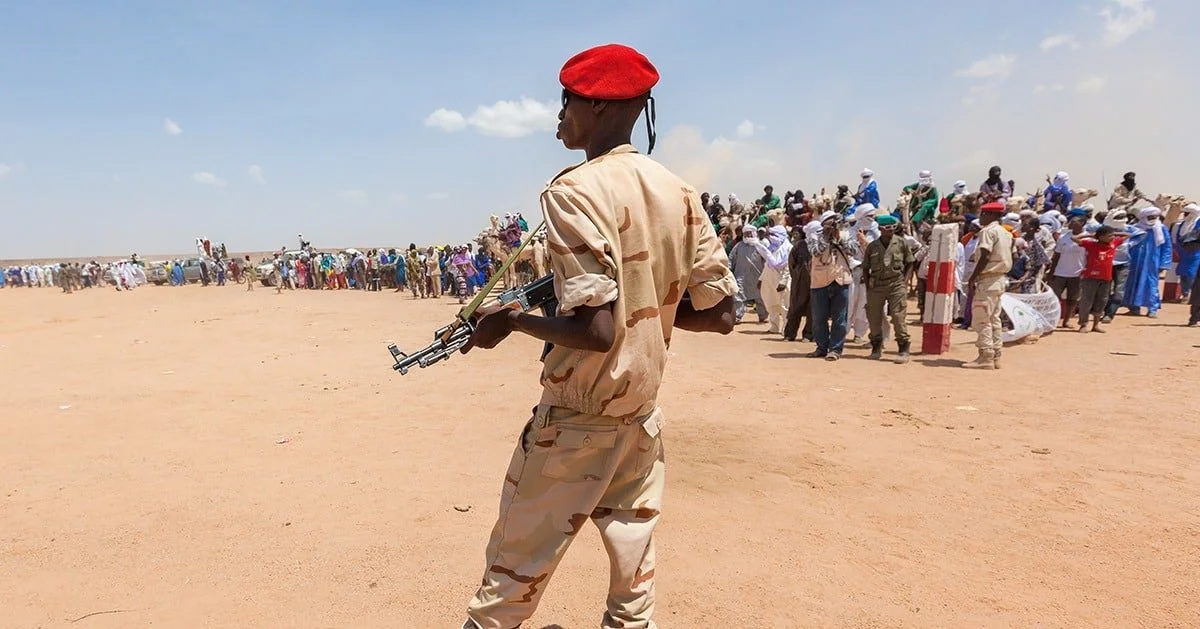
Military coup in Niger. Picture credit: gfmag.com
What looks like political instability is, in fact, a constitutional pattern. Since 2020, military takeovers have reshaped Francophone Africa, occurring in Mali (twice), Chad, Burkina Faso (twice), Niger and Gabon. Commentary often attributes these developments to “poor governance,” a label too broad to explain the pattern.
This piece examines these takeovers through the lens of African constitutional law, drawing on the African Charter on Human and Peoples’ Rights and African Union (AU) norms on unconstitutional changes of government. It distinguishes two types of coups: conservative coups which preserve existing external security and monetary arrangements, and revolutionary coups which disrupt them. These labels describe the extent of that disruption, not the junta’s ideologies.
Two legal problems follow: a structural sovereignty deficit arising from monetary and security arrangements, and a procedural deficit arising from the AU’s uneven enforcement of its prohibition on both types of coups.
The Structural Deficit
Under the 1962 UN General Assembly resolution, peoples, not political elites, hold permanent sovereignty over natural resources. Critics describe France’s political, military and commercial ties with its former colonies as “Françafrique,” referring to networks built to preserve French influence. Three features matter.
First, the CFA franc. Fourteen states remain tied to France through the currency, whose peg to the euro France guarantees. In the Central African zone, the regional central bank must keep half of its foreign-exchange reserves in an operations account at the French Treasury. Second, French military basing. Third, external security guarantees.
Together, these arrangements constitute a sovereignty deficit under Articles 20 and 21 of the African Charter. They place monetary, defence, and resource decisions partly beyond the reach of elected governments, yet Article 20 affirms that peoples “freely determine their political status,” while Article 21 provides that they freely dispose of their natural resources.
Do these arrangements violate the Charter? The Commission has never ruled on a monetary union. Its closest authority, SERAC v. Nigeria (2001), found an Article 21 breach where a state allowed resource exploitation to proceed at its people’s expense. SERAC does not directly govern monetary unions, but it establishes that states may not allow external arrangements to harm their people’s control over resources.
The fit is by analogy, since reserves are not natural resources, and joining a treaty is itself an exercise of sovereignty; de facto limits alone do not constitute violations. Article 21(5), which addresses the elimination of foreign economic exploitation, offers a firmer hook, but claimants would need to demonstrate a lack of public oversight, an absence of power to renegotiate, and demonstrable harm to the people. A communication could test this argument.
Two Types of Military Takeover, One Legal Standard
The AU’s Lomé Declaration (2000) and its African Charter on Democracy, Elections and Governance (2007) prohibit unconstitutional changes of government without exception. Article 23 identifies prohibited means, including coups against elected governments and constitutional revisions that undermine democratic change.
Chad’s 2021 takeover represents the conservative coup. A Transitional Military Council installed Mahamat Déby after his father’s death, bypassing constitutional succession. Mali (2020 and 2021), Burkina Faso (2022) and Niger (2023), by contrast, represent revolutionary coups. Their juntas expelled French forces and moved toward monetary sovereignty. Mali was suspended from ECOWAS and blockaded within days. Niger faced an ECOWAS ultimatum, backed by France, that raised the prospect of military intervention.
“If elections cannot durably shape monetary, security and resource decisions, constitutional design must pair domestic accountability with safeguards against external constraints”.
The two organizations enforce the prohibition differently. The AU primarily suspends member states, while ECOWAS can impose sanctions and threaten the use of force under its 1999 Mechanism and 2001 Protocol.
The AU Peace and Security Council (PSC) decides case by case, and its responses appear to reflect geopolitical alignment more closely than consistent legal principles. In April 2021, it expressed “grave concern” over Chad’s Transitional Military Council. By May, citing the “complexity” of Chad’s situation, it welcomed a transitional government and urged its officials not to contest elections. Mahamat Déby subsequently did so and won in 2024. Lomé Declaration permits such discretion through graduated, “limited and targeted” sanctions.
Two anomalies stand out. Gabon (2023) coup appears to be an exception but remains a conservative coup. Its leader, General Oligui Nguema, is the ousted president’s cousin. The Bongo-era elite returned to its position, while French interests remained untouched. Nevertheless, the AU still suspended Gabon a day later, applying a norm that covers both types of coups.
Chad is the true anomaly. Its transitional military council bypassed constitutional succession just as Niger’s junta did, yet only Niger faced sanctions. The typology predicts what a junta changes, but not how the AU responds. The principle of opposition to unconstitutional changes of government does not explain this disparity.
What the Jurisprudence Says About Sovereignty
The Commission has held that neither domestic law nor popular will can strip citizens of their Article 13 right to participate through “freely chosen representatives” (Legal Resources Foundation v. Zambia). It has also held a state responsible for violations committed during a contested election (Zimbabwe Human Rights NGO Forum v. Zimbabwe).
Afrobarometer’s surveys capture the public mood. Round 9 (2021–2023) found that two-thirds of Africans preferred democracy, yet across 39 countries, 53% would tolerate a military takeover when elected leaders abuse power. Such acceptance does not make a coup lawful; rather, it signals unmet Charter guarantees.
The enthusiasm for revolutionary coups in Bamako, Ouagadougou and Niamey compared with the response to Chad’s succession suggests that citizens are reacting to the sovereignty deficit.
Military Takeovers Rarely Fix the Structure
Even revolutionary coups rarely dismantle the CFA franc or French military basing arrangements. In Mali, French forces withdrew in 2022, and Russian units took their place. Replacing one external partner with another does not deliver the sovereignty envisaged in Article 20; sovereignty means having the freedom to choose one’s partners.
If the structural deficit persists, coups will remain attractive to citizens, regardless of their legality.
A Question for Constitutional Design
One reform is essential: securing sovereignty through legal architecture rather than political culture. If elections cannot durably shape monetary, security and resource decisions, constitutional design must pair domestic accountability with safeguards against external constraints. Parliamentary approval of every defence and basing agreement would be a starting point.
Regional bodies must also apply the prohibition on “unconstitutional change of government” consistently. Until elections deliver real sovereignty, takeovers will continue to attract public acceptance. This is a legal question, not a geopolitical one.