
Botswana's Journey from Beyond Decriminalisation to Full Equality
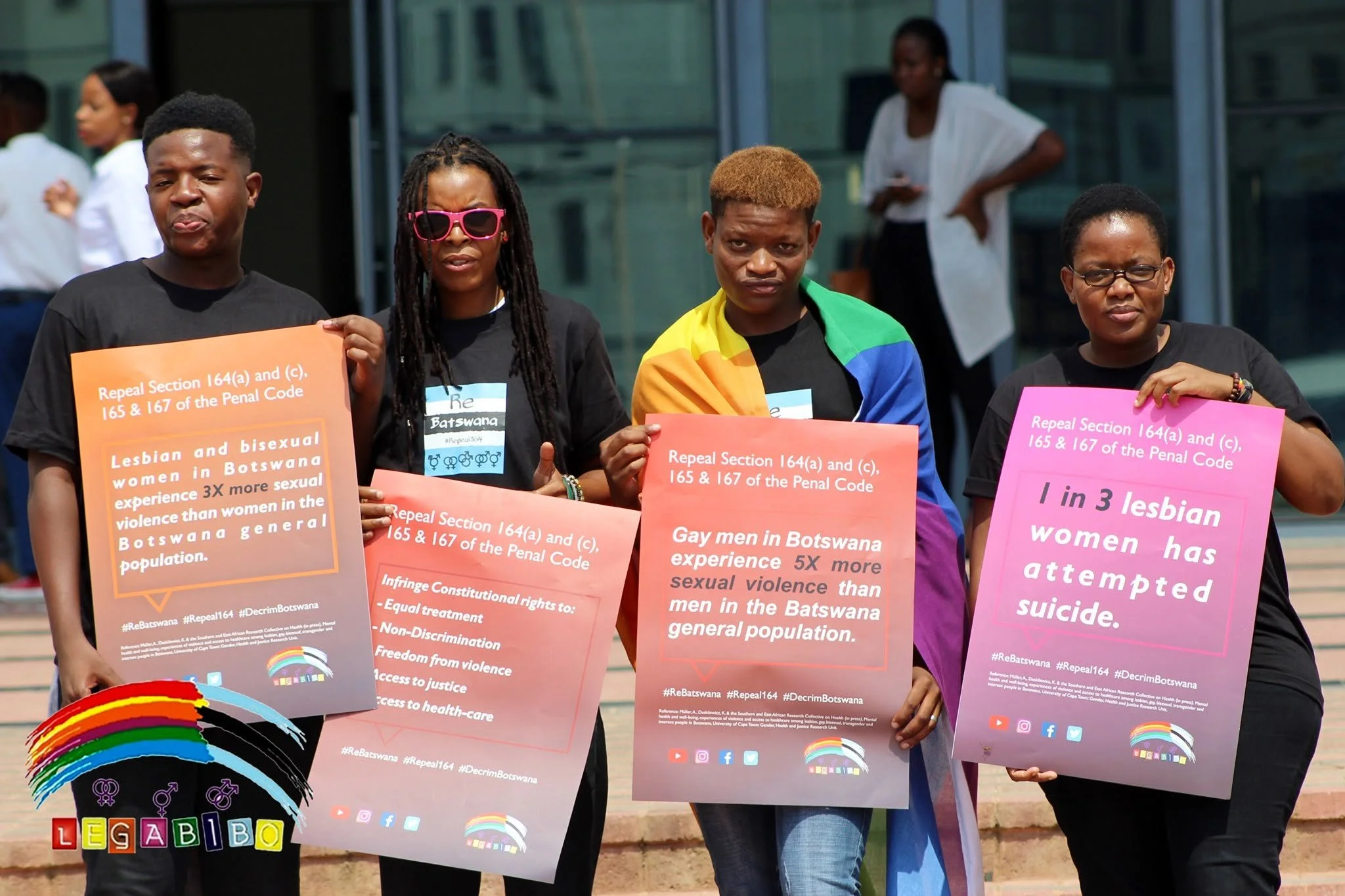
Picture Credit : Lesbians, Gays and Bisexuals of Botswana - LEGABIBO
This Article will examine recent attempts to implement and comply with the landmark judgment that decriminalised consensual same-sex sexual relations in Botswana and the lessons drawn from those processes.
When Botswana's High Court handed down its landmark judgment in Letsweletse Motshidiemang v Attorney Generalin June 2019, declaring sections 164 (a) and (c) and 167 of the Penal Code that criminalised consensual same-sex sexual relations unconstitutional, it did far more than strike down discriminatory colonial-era laws. It affirmed the constitutional principle that every person, regardless of their sexual orientation, gender identity and expression, is entitled to dignity, liberty, privacy and equal protection under the law. That decision, unanimously upheld by the Court of Appeal in November 2021, has become one of the most significant human rights victories in Botswana's democratic history and arguably one of the defining constitutional judgments on the African continent. It is important to note that the Court of Appeal only upheld the repeal of sections 164 (a) and 164 (c) of the Penal Code, not section 167,thus section 167 of the Penal Code still exists as law. Not yet uhuru!
Communities at the core of litigation
The courts have recognised that winning in court is only one aspect of the journey towards full equality and that we also need to win the hearts and minds of society. One of the Southern Africa Litigation Centre’s (SALC) ways of working is to ensure that the strategic litigation journey is informed by the needs of the affected or concerned community because the outcome of the case impacts not only an individual but an entire population for a long time. It is crucial that communities have ownership of the cases, understand the matters, provide direction, and can articulate its fundamental essence to the broader public. After all, it is their lived realities that inform constitutional reform. In Botswana, SALC working alongside the leading community advocacy organisation, Lesbians, Gays and Bisexuals of Botswana (LEGABIBO), understood this from the outset. The work has never been confined to the courtroom. This inclusive winning formula has been about ensuring that constitutional victories become meaningful protections in the everyday lives of LGBTIQ+ persons and other marginalised groups.
A win for one marginalised community is a win for all marginalised communities
Throughout the process, LEGABIBO ensured that the voices and lived experiences of Botswana’s sexual and gender minorities remained central to litigation, while SALC provided legal and technical support to LEGABIBO and its members. This was achieved insofar as the community contributed real-life evidence on the impact of laws that criminalise LGBTIQ+ daily, and through LEGABIBO as amicus curiae, presented this evidence to the courts, illustrating how criminalisation fuelled stigma, discrimination, violence and barriers to healthcare, employment and justice. Collectively, they demonstrated that colonial laws serve no legitimate constitutional purposes but rather inequality and exclusion.
A long walk to freedom, recognition and dignity
Change from litigation does not happen overnight, the journey to decriminalisation started in incremental steps. This journey began in 1994 with Kanane v the State, where the courts upheld sections of the Penal Code that criminalised consensual same-sex relations on the basis of public interest and morality. This set in motion what would later help inform our advocacy strategies and arguments in court. So, if we had to start from 1994, when Kanane was charged and the judgment handed down in 2003, to 2021 when the Court of Appeal decriminalised consensual same-sex relations, we could say that the decriminalisation process took 27 years. Twenty-seven years of careful documentation, research, advocacy, strategizing, awareness raising, coalition building, lobbying, fundraising and litigation by various human rights defenders, activists and organisations.
One of the successes of the litigation journey is not just removing discriminatory laws but also shifting public discourse in Botswana. As the case was ongoing, there were several public conversations about it on the radio, in newspapers, on public transport, in social circles, the Kgotla (which is a traditional community meeting place, public council, and customary court setting in Botswana) and even in religious spaces. However, not everyone had the same opinion. The Court’s rejection of both the notion that the public is not ready and the opinion of the majority (which was not supportive of sexual and gender minorities) was an important step in reaffirming that the courts must reinforce and protect the fundamental rights of marginalised and unpopular groups.
The litigation strategy was also informed by a broader strategy to create positive jurisprudence on equality and dignity in the Botswana courts. Court of Appeal decisions in which SALC was involved, such as the Mmusi and Others vs RamanteleandTapela and Others vs Attorney General cases enabled the successful litigation in the Rammoge case and eventually the Motshidiemang case. Going into litigation without having ensured that some fundamental legal principles are fully embedded in the courts would have risked a negative outcome.
The wheels of justice in motion
Since the judgment, Botswana has seen increasing reliance on the Constitution to address broader questions affecting equal rights. The ongoing marriage equality case before the High Court shows how decriminalisation has contributed to laying the foundation for equality. In the 2016 Attorney General vs Thuto Rammoge and 19 others case, where LGBTIQ+ people sought the right to freedom of association, assembly and expression, the Court of Appeal said that:
“Members of the gay, lesbian and transgender community, although no doubt a small minority, and unacceptable to some on religious or other grounds, form part of the rich diversity of any nation and are fully entitled in Botswana, as in any other progressive state, to the constitutional protection of their dignity.”
The courts further affirmed that identifying as LGBTIQ+ is not, in itself, a crime. Once they recognised that sexual orientation and gender identity cannot legitimately be used to justify criminal punishment, it became increasingly difficult to defend legal exclusion solely on the basis of sexual orientation or gender identity.
Indeed, attempting to maintain such exclusion while simultaneously affirming these principles is difficult to justify and risks appearing internally contradictory, thereby undermining the coherence and legitimacy of the judiciary’s reasoning.
Delays in court rulings delay fulfilment and enjoyment of equal rights.
Implementation of judgments and court orders has not been one of Botswana’s strong points, demonstrating that success in court does not result in immediate or automatic legal reform. For five years, since the Court of Appeal judgment, section 164 (a) and (c) have remained in the printed versions of Botswana’s Penal Code despite no longer being enforceable. The government's delay in removing the section from the Penal Code may have left some people confused. In 2023, we saw politicians tabling the Bill to section 164 from the Penal Code after the Courts had lawfully done so. It led religious leaders and opposition parties to call for the Bill to be debated. SALC’s position, however, was that the Court had already ruled that the criminalisation of consensual same-sex relations was contrary to the Constitution, the supreme law of the country. Parliament therefore did not need to reconsider the constitutionality of the provisions; rather, it simply needed to give effect to the Court’s judgment by administratively removing the provisions from the Penal Code. An important lesson from this episode is that the effectiveness of judicial decisions depends not only on the issuance of judgments and orders, but also on corresponding administrative and legislative compliance.
In March 2026, the government published a notice amending the Penal Code by deleting sections 164(a) and (c). The Botswana government thereby took the important step of formally removing the unconstitutional provisions from the Penal Code and bringing the statutory framework into alignment with the Constitution. This process has, however, been subject to considerable debate, with opponents arguing that the Attorney General lacked the authority to effect the amendment and that the matter should instead have been determined by referendum. The Attorney General’s decision nevertheless marked an important moment in giving effect to the State’s obligation to comply with judicial decisions and to ensure that legislation is brought into conformity with constitutional requirements.
SALC and LEGABIBO have continued to monitor this process and its implementation. Ensuring compliance with judgments also requires a level of understanding of the law. This required continuous advocacy, legal empowerment and lobbying to address this gap. Decriminalisation was not just for LGBTIQ+ people but for everyone facing any form of discrimination, violence, prejudice and exclusion.
“Equal rights do not implement themselves. Governments must act, institutions must comply and society must gradually embrace the constitutional values articulated by the courts.”
The road to implementation has revealed the complexities of society and our understanding of it. This administrative reform has garnered international recognition for Botswana and its progressive constitutional jurisprudence, but societal acceptance and understanding have not been at the same pace. Anti-rights and anti-gender actors are increasingly organising and attempting to show constitutional rights as a threat to Botswana’s traditions and African values. They are seeking to reverse the gains made through strategic litigation. This is why continuous monitoring of implementation is important, as it helps protect the gains that have been made from being reversed.
The 2019 and 2021 judgments formed part of a trajectory in Southern Africa where countries such as Angola and Namibia have abolished colonial laws criminalising consensual same sex relations. Botswana’s decision contributes to the broader regional conversation about equality, dignity and the rule of law. The courts have shown that despite some African States being reluctant to protect the rights of sexual and gender minorities, they are willing to do so. Although section 167 remains in the Penal Code, its repeal would complete Botswana’s transition towards full decriminalisation of consensual same-sex relations. Botswana therefore offers several important lessons concerning the role of strategic litigation, the limits of judicial intervention, and, critically, the need for effective administrative and legislative measures to implement and give practical effect to court rulings.