
Rethinking Equality in the Age of Artificial Intelligence: Beyond the Digital Divide in Africa
Editor’s Note: This blog post is part of the Many Faces of Inequality series, featuring selected papers presented at SAIFAC's ‘Many Faces of Inequality’ Colloquium (4–5 August 2026).
Inequality has historically been understood primarily as a matter of access: who held land, who held office, and who had a seat at the table.
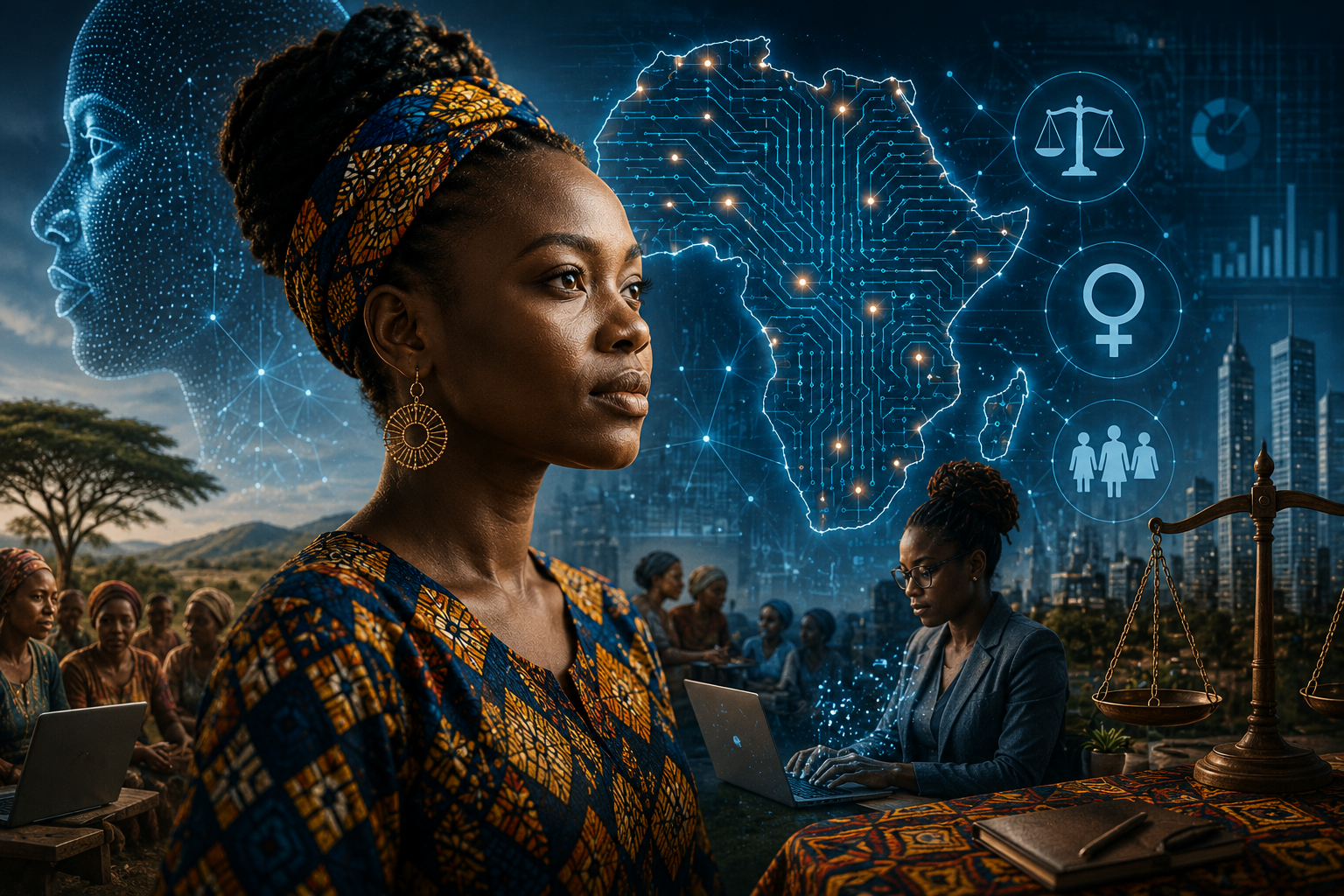
Over time, that framing of equality has become insufficient. In the age of artificial intelligence (AI), inequality has acquired a new form, one that does not ask for a seat and does not need to be noticed to do its work. It is written into data, creating a new reality for its users. The question that usually opens a conversation about AI and inequality in Africa is: who designed the system? But the question should go deeper than that. Where are the African women in the room? Where are the rural communities, the informal traders, and the people whose entire economic and social lives sit outside the categories a dataset was built to recognize? Whose wisdom and lived experience actually made it into the data on which African AI systems are now trained, and whose did not?
The algorithm as the gatekeeper
Across the continent, as across the rest of the world, the rooms where AI is built rarely reflect the populations those systems will serve. Women are missing from AI design, development, and governance at almost every level, as engineers and as researchers. That absence produces a specific and often unaddressed kind of harm. An AI credit-scoring tool built by a team with no women in it, trained on data that reflects male patterns of formal financial activity, may systematically undervalue the creditworthiness of a woman who trades, farms, and saves communally. Her economic life may be informal, and her financial history may not be the kind the system was built to recognise.
AI can embed existing inequalities into the systems that make decisions about people. When these systems rely on incomplete or unrepresentative data, they can reproduce existing biases and create new forms of discrimination. This is concerning where AI is used to make decisions about healthcare, education, employment, and financial services, where an individual may have little ability to challenge or even understand how a decision was made.
What makes the AI-era version of exclusion different is that it no longer requires participation to cause harm. The old digital divide excluded people from systems they could choose not to use; this one does not ask permission. A woman assessed by an algorithmic credit model cannot opt out of its judgment. A woman who has traded, farmed, and saved through her local tontine her whole life presents to a credit-scoring algorithm as a liability, not because she lacks a financial history, but because her history was never the kind the system was built to read.
The current legal framework
There is already a plethora of constitutional and legal frameworks in place. The African Charter, the Maputo Protocol, and instruments like the Convention on the Elimination of All Forms of Discrimination Against Women (CEDAW) give women a strong legal floor. The problem is not that equality law is irrelevant to AI, but that these frameworks were designed on the premise that discrimination can be traced to an identifiable human decision-maker or institution, whose decision can then be challenged through an ordinary legal process. Traditional equality law is built around a discrete decision made by an individual such as a hiring manager who declines to promote a woman, or a particular institution who hires only men. That decision can be examined, and the decision-maker held to account, typically by proving human prejudice or intent. An algorithmic outcome has no single point like that. It emerges from a pipeline: the data that trained the model, the choices made by the engineers who built it, the criteria set by the institution that deployed it, and the context in which it is finally used. Current equality laws were designed for individual human decision-makers, not distributed software systems, so responsibility ends up spread across developers, data providers, employers, and platform operators, each able to claim the harm originated elsewhere in the chain. A law built to find one prejudiced decision-maker struggles when the harm was produced by all of them and none of them at once. So where does responsibility lie?
International law is only beginning to answer that question, and it is doing so unevenly. CEDAW itself has started to reach into this territory, in October 2024, the Committee on the Elimination of Discrimination against Women adopted General Recommendation No. 40, setting a 50-50 parity standard for women's representation across decision-making systems, explicitly including digital and algorithmic spaces. It is guidance, not a binding rule with its own enforcement mechanisms. That leaves a gap that responsibility-attribution alone cannot close. Until that gap closes, the question of where responsibility lies remains open.
Taking a step for Africa
HerSafeSpace, Nigeria, launched at the Global AI Action Summit in Paris in February 2025 by the Brain Builders Youth Development Initiative, is an AI-powered chatbot built to combat online gender-based violence across West Africa. It is one of the few GBV-focused AI tools built specifically for a West African, Francophone-adjacent context, rather than adapted after the fact from a tool designed elsewhere. What makes HerSafeSpace different isn't simply that it was built by an African organization, but that it was built for a specific population's lived reality, West African, Francophone-adjacent women navigating online gender-based violence, with that population's needs shaping the system from the first design decision, rather than a general-purpose tool later adjusted to fit them.
What rethinking equality actually requires
Closing the gap between what equality means and what AI does to inequality means standing at the point where law meets technology, and asking not only who AI serves, but who it leaves behind. The first move is from reactive to preventive equality that will ask whether safeguards existed before an AI system was deployed, not only whether harm can be proven after.
The second move is design-stage accountability that will shift the burden onto developers and deployers to show they took reasonable steps to identify and mitigate discriminatory risk before a system is deployed, rather than leaving affected women to prove discrimination after the harm is done.
The third move is meaningful participation, not consultation after the fact, but African women, rural communities, and informal-economy workers shaping what a system is built to do.
The fourth move is equitable benefit where African women are entitled to share in the value AI-driven growth generates, not simply absorb its risks. This means data generated by their own economic and social activity should be treated as a resource in which they have a stake, not raw material extracted for someone else's model.
Where this leaves Africa
Africa is already deciding how AI will be governed through national AI strategies, data protection laws, digital policies, infrastructure choices and emerging regional frameworks. What is decided now will shape who has access to AI, who controls its development, whose data and resources are used, and who ultimately benefits from the value it creates. We should not wait until these rules are settled and these systems are entrenched before asking where equality fits in the agenda. This is the moment to ensure that equality is not an afterthought in AI governance, but one of the principles on which Africa's AI future is built.