

Cameroon’s New Vice Presidency: Interrogating the Constitutionality and Democratic Quality of the Presidential Succession Framework
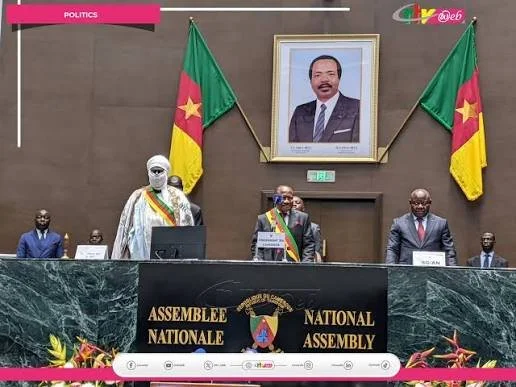
Picture Credit: Business in Cameroon
In April 2026, Cameroon’s Parliament approved a constitutional amendment which among other things, reintroduced the position of the Vice President (VP) into the framework of executive power.
Crucially, article 6(5) of the Constitution designates the VP as the successor of the President in case of a vacancy resulting from the President’s resignation, death or permanent incapacity duly established by the Constitutional Council. In such a case, the VP shall complete the term of office of the President. Pursuant to article 10, the President is responsible for the appointment of the VP and can terminate the same.
Although the position of a VP is not an innovation in Cameroon’s constitutional history, the April 2026 amendment has caused some disquiet for reasons which go to the heart of Cameroon’s democracy and its existence as a constitutional state. This post interrogates the constitutionality and democratic quality of the succession regime. It further reflects on the effects of the extension of presidential powers and the pattern of abusive constitutional amendments in Cameroon.
The Question of Constitutionality
A pertinent question regarding the amendment is whether the method of succession provided by article 6 is consistent with the procedural requirement for accession to the presidency. A holistic reading of the relevant provisions of the Constitution, article 5(2) and article 6(1) – (3) provide a clear indication of the democratic procedural requirements for accession to the position of the president; requirements which the April amendment seems to have elided. Article 5(2) provides that the President of the Republic is ‘[e]lected by the whole Nation’.
Implicitly, the position of the President is elective, therefore grounded in avital element of democracy. Article 6(1) – (3) confirm this democratic element in its stipulation on the requirements for presidential elections which include the qualifying electoral majority, voting method, franchise, timing of elections and presidential term. The amendment fails to take cognizance of this fundamental democratic element. The fact that the VP can complete the remainder of the presidential term in the event of a vacancy undermines this democratic element as it implies that a potential head of state can serve in an elective office, despite not having acceded to that position through elections.
To further highlight the unconstitutionality of the amendment, it is important to look at the previous succession framework under which the Speaker of the Senate was designated constitutional successor of the President. The former assumed interim succession in the event of a vacancy of the presidency as the Constitution (former article 6(4) (a)) required the organization of presidential elections within a maximum period of 120 days. It was clear that upon assumption of the presidency in the event of a vacancy, the Speaker’s new presidential role was temporary to ensure constitutional continuity and political stability, while facilitating the democratic process of electing a new president.
“The extension of presidential powers in Cameroon through constitutional amendments is not new and reflects a pattern of unconstitutionality and abusive constitutionalism.”
That framework was an implicit recognition that a person who succeeded the office of the President due to a vacancy as constitutionally established, could hold office only for as long as was necessary to enable the democratic process of electing a new leader, in line with the Constitution. The amendment creates a normative tension within the Constitution by departing from the democratic logic reflected in articles 5(2) and 6(1)–(3)
A Presidential Successor Devoid of Democratic Legitimacy
The amendment paves the way for an undemocratic presidency, as the VP will potentially hold the elective office of the President without having stood for election. An unelected presidential successor poses a challenge to the basic tenets of democracy as they lack democratic legitimacy.
A review of the evolution of the constitutional provisions on presidential succession reveals the democratic underpinnings of the presidency as previous frameworks prescribed a temporary succession mechanism. Article 10 of the Federal Constitution of 1961 provided for a VP who assumed succession ‘in the event of the Presidency falling vacant’ and was to hold office ‘until such time as a new President is elected’. That provision prescribed a minimum period of twenty days and a maximum period of fifty days within which presidential elections were to be scheduled.
This was the case despite the fact that under article 9 of the same Constitution, the President and VP were elected ‘on a single list, by universal suffrage’ indicating that both officials obtained a democratic mandate. Yet, the constitutional drafters in recognition of the democratic underpinnings of the presidency, mandated through article 10, that even the VP required an independent electoral mandate to serve as a President.
Another example is article 7 of the 1972 Constitution which designated the Speaker of the National Assembly as the successor of the President in the event of a vacancy. It prescribed a specific time limit of forty days for the election of a new president. Further, as discussed previously, under the 1996 Constitution prior to the April amendments, the Speaker of the Senate was designated constitutional successor of the President, and the former was to hold office for a period not exceeding 120 days during which presidential elections were to be held.
All these transformations of the succession framework demonstrate an implicit recognition that an unelected successor to the presidency holds office as an interim mechanism to pave the way for a democratic process which grants a prospective president the democratic legitimacy to hold office. They confirm that the position of the President is an elective one, and the office holder derives legitimacy through a democratic process. In designating a presidential appointee as the presidential successor, the new article 6(5) undermines the democratic legitimacy of the presidency.
Authoritarian Consolidation of Presidential Powers and Abusive Constitutionalism
According to article 10(1), the President can appoint and dismiss the VP without any limits on the exercise of these powers. Moreover, the Constitution provides neither qualifying criteria for a VP, nor reasons for the termination of their appointment. In addition, the VP’s duties are defined by the President and the former can only exercise delegated presidential powers. Besides their succession duty, the Constitution provides no specific role for the VP.
The VP appears to serve at the pleasure of the President. The additional power to appoint and dismiss the VP provides ideal conditions for authoritarian consolidation. It allows the President to handpick a successor who has every interest in remaining subservient to him. These observations reinforce existing concerns about the scope of presidential powers and the extensive control exercised by the President over state institutions.
The extension of presidential powers in Cameroon through constitutional amendments is not new and reflects a pattern of unconstitutionality and abusive constitutionalism. The amendment process itself presaged its substantive deficiencies, having been concluded within two days of Parliamentary proceedings, shrouded in secrecy. It undermined the credibility of the process and the democratic expectation of genuine deliberation amongst elected representatives in both Houses of Parliament. It also eschewed good faith dialogue with the wider society, for instance through meaningful engagement with civil society organisations.
Unfortunately, despite the deficiencies identified, the amendment is unlikely to be challenged. The Constitutional Council, which has jurisdiction in such matters, is inaccessible to ordinary citizens who may have the interest to challenge the constitutionality of the amendment. Power therefore remains in the hands of the politicians who can make and unmake constitutional rules with little institutional restraint.