
Kenya’s Sharpeville Moment? June 25 and the Road Ahead
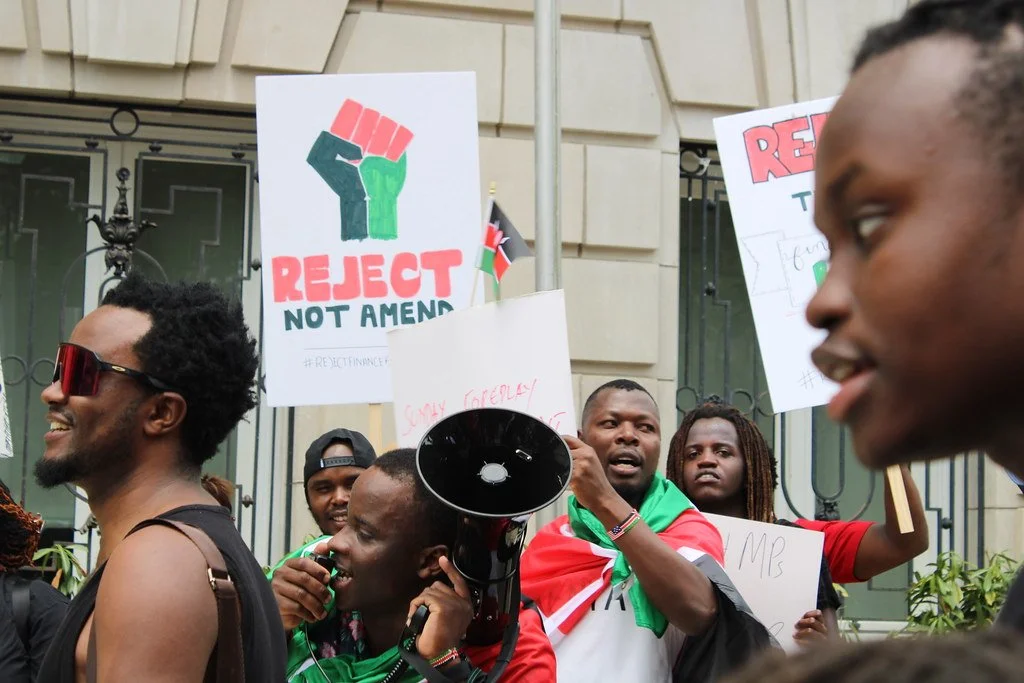
Picture Credit: 6/23 DC Protest for Kenya #7" by deebr츩 is licensed under CC BY-ND 2.0.
Today, Kenya marks two years since the watershed Gen Z-led protests that culminated on June 25, 2024, when thousands of young people, catalysed by Kenya’s Finance Bill 2024, took to the streets demanding greater government accountability.
The protests awakened a generation frustrated by the government’s unwillingness or inability to address worsening governance and socio-economic concerns that resulted in both a decline in public trust and erosion of constitutional rights and freedoms.
Two years on, the main question is, what changed, and perhaps even more importantly, what can the movement still achieve going forward? In the immediate aftermath of the protests, the government acknowledged the importance of the issues raised by the people and called for dialogue. The protesters, however, insisted that the governance issues raised did not require negotiation but action on the part of the government. There have also been promises to compensate the victims, and most recently, an attempt by some leaders to frame the movement as young people causing disorder and thus needing to be disciplined, ignoring legitimate calls for better governance.
History teaches us that certain events have a profound impact on nations and global history, redefining its course, transcending time, and serving as catalysts for profound change. In this regard, the character and scale of the June 25 protests invite comparison with South Africa’s Sharpeville protests of March 21, 1960, which galvanised resistance in South Africa, captured the attention of the world on the ills of apartheid, and shaped the international human rights system. Drawing lessons from Sharpeville, the question is, can June 25 serve as a catalyst for lasting transformation rather than becoming another missed opportunity in Kenya’s democratic journey?
June 25 Gen Z-led protests in Kenya
On June 25, 2024, the world witnessed extraordinary scenes in Nairobi. Thousands of young people, who for weeks had been opposed to the Finance Bill 2024, which sought to raise taxes, came out in the streets for the second week to protest the tax increases. In the preceding days, Parliament had been warned, mainly by the young people but also religious leaders, not to pass the bill, which led to some tax measures being dropped, but not enough to satisfy public outrage.
The proposed tax increases threatened to reduce people’s disposable income, thus weakening their ability to enjoy the economic and social rights guaranteed under Article 43 of the Constitution.
In practice, the realisation of the economic and social rights in Kenya heavily depends on household purchasing power. In addition to high taxes, government failures, such as corruption and inflation, can result in further reduction in people’s access to essential goods and basic services.
On June 25, Parliament hurriedly passed the bill despite the ongoing protests, further intensifying public outrage and fuelling the demonstrations, which had been coined, ‘Occupy Parliament’ as an appeal to MPs not to pass the bill. As the day progressed, the number of protesters increased, and so did state violence. By evening, several protesters lay dead on the streets as the police used lethal force.
One of the defining images of the protests was that of a young man fatally wounded by gunfire, covered with a Kenyan flag by fellow protesters as they sang the national anthem. The scene captured both the scale of the violence and the protesters’ sense of patriotism. On the evening of the protests, President Ruto addressed the country and thanked the young people for “helping our country organise our democratic discourse around issues.” He also pledged that ongoing public discussions on national issues would inform government policy, and committed to fostering issue-based, non-tribal dialogue while creating processes to turn these discussions into action. He subsequently made a concession not to sign the bill and expressed regret at the loss of life and destruction of property during the protests. A week later, the president announced cuts to government spending and a week after that, he dissolved his Cabinet.
The total number of deaths that resulted from the series of Gen Z-led protests in 2024 and 2025 has been reported to be 128 by Amnesty International. There were also reports of abductions, arbitrary arrests, torture, and sponsored gangs in the protests.
The protests signalled a revitalised shift from complacency to active participation by the people through exercising their constitutional rights in Article 37 to assemble, to demonstrate, and to picket, as they saw no bright future if the status quo remained as it was. They united Kenyans in unprecedented ways, arguably more than any other initiative in Kenya’s history. Religious leaders estimated that over 85% of Kenyans supported the protests. Even the President recognised that the protests were issue-based, tribeless, and they were about critical national issues.
Lessons from Sharpeville for Kenya
The Sharpeville protests and the Gen Z-led protests in Kenya represent a moment when young people robustly challenge the State over laws and practices they consider unjust, at great personal risk. In both instances, the protests were repressed violently by the police, resulting in fatalities.
‘Drawing lessons from Sharpeville, the question is, can June 25 serve as a catalyst for lasting transformation rather than becoming another missed opportunity in Kenya’s democratic journey?’
However, the comparison is in fact more useful because of what transpired later. Sharpeville exposed the political and moral limits of the apartheid regime, which helped catalyse resistance in South Africa. Furthermore, it captured the attention of the international community, paving the way for governance transformation in South Africa, and shaping the global human rights regime. The protests, therefore, were a turning point as they paved the way for sustained structural change.
Further, it is often argued that ‘Sharpeville was the beginning of the end of apartheid’. Six years after Sharpeville, the UN declared March 21 to be the International Day for the Elimination of Racial Discrimination in commemoration of the Massacre. Notably, South Africa’s post-apartheid Constitution was signed at Sharpeville, on December 10, 1996, where President Nelson Mandela attributed the democratic and human rights gains in South Africa to “the many Sharpevilles” that inculcated the principles of “respect for human life, liberty and well-being”. Furthermore, Sharpeville inspired artistic development, including concerts and songs such as ‘senzeni na’ (what have we done?). It is also often argued that without the Sharpeville massacre, the world may not have the international human rights system that we have today.
The said gains were achieved despite the introduction of draconian laws by the Apartheid government to repress the activities of the anti-apartheid activists and movements that were responsible for the protests, and widespread arrests of protesters. Sharpeville teaches us that transformative change requires sustained public vigilance for accountability and rights-respecting governance.
Similarly, the June 25 protests in Kenya were a departure from previous ones. Unlike earlier protests, which were mostly mediated through political elites, the young people-led protests were largely leaderless, cross-cutting and resistant to co-optation. Also, like Sharpeville, which was against pass laws but also challenged the apartheid system, the June 25 protests challenged not just specific policies, such as high taxation but also broader governance issues, which led to immediate reforms such as the dissolution of the Cabinet.
The road ahead
June 25, 2024, was a moment of courage for Kenyan youth, some of whom paid the ultimate price fighting for their rights. However, as demonstrated by Sharpeville, such moments often trigger greater repression rather than transformation. Indeed, after the Gen Z protests in Kenya, there has been a pattern of intimidation, surveillance, and abductions suspected to be initiated or facilitated by the state to deter dissent.
However, Sharpeville also teaches us that such moments can lead to renewal. The question, therefore, is whether Kenya’s protests will result in systemic reform and transformation. Fortunately, unlike apartheid South Africa, Kenya has a transformative constitution that guarantees socioeconomic rights, the right to life, the right to assemble, demonstrate and picket, among other rights; it just needs to be implemented.
The Kenyan Gen Z-led demonstrations arguably already inspired similar protests abroad, including in Uganda, Tanzania, Madagascar, Mozambique, Nigeria, Nepal, and Bangladesh, among others - some of which went as far as forcing regime change. It remains to be seen whether Kenya will export people-led reforms and transformation abroad, but lag domestically.
Learning from Sharpeville, several other questions arise that may shape the future of governance in Kenya. Did June 25, for example, expose the political and moral limits of the Kenyan regime, such as respect for human rights, including life and liberty? And if Kenya experiences democratic transformation following the 2027 general elections or later, will it one day be argued that such a political shift would not have been possible without the June 25, 2024, Gen Z-led protests?
Conclusion
Wendell Phillips once observed that "Eternal vigilance is the price of liberty.” The promise of June 25 depends on whether the public and institutions sustain vigilance. President Ruto's acknowledgement that young people initiated an important conversation also points to a likely path to reform and transformation.
Further, perhaps a symbolic step such as formally recognising June 25 as a national day of democratic accountability or human rights, for example, just like March 21 in South Africa, could help anchor the spirit and the sacrifice of the young Kenyans in Kenya’s institutional memory, ensuring their courage, passion and patriotism do not fade into history, and serve as a tribute to those who lost their lives or suffered injuries. It would also be a day to recommit and call to action for a society committed to human rights and democratic values.
Ultimately, the test for the country is whether its democracy will be transformed to be more responsive, accountable, and people-centred.