

The Banjul Declaration on Sudan: When African-Led Accountability Risks Enabling Impunity
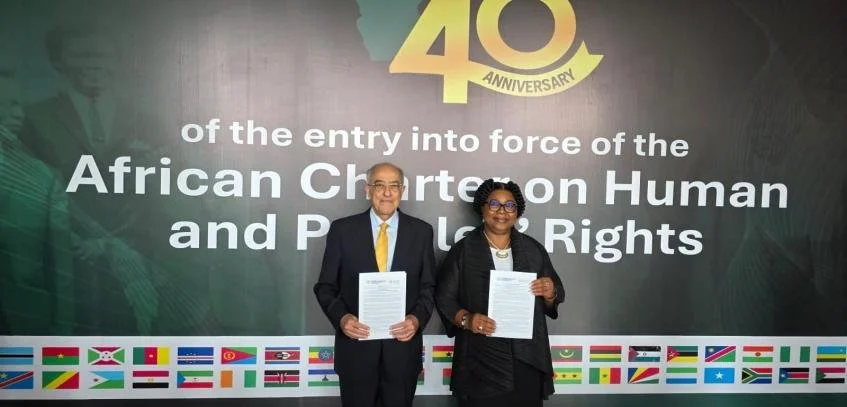
Picture Credit: African Commission on Human and People’s Rights
The Declaration and Its Structural Contradiction
The Banjul Joint Declaration on Sudan, adopted on 12 May 2026, endorses a principle it cannot operationalise: that an African-led accountability mechanism can function in complementarity with the International Criminal Court (ICC) while occupying a distinct doctrinal space.
Jointly adopted by the African Commission on Human and Peoples' Rights Fact-Finding Mission and the United Nations (UN) Independent International Fact-Finding Mission (IIFFM) for Sudan, the Declaration arrives after ICC Trial Chamber I's twenty-year sentence (9 December 2025) on Ali Muhammad Ali Abd-Al-Rahman (Ali Kushayb) whose conviction (06 October 2025) was the first the Court had ever secured in a Security Council-referred situation. Thus proving, for the first time, that the ICC's referral mechanism can produce results.
It arrives, too, against the backdrop of the Alliance of Sahel States (comprising Burkina Faso, Mali and Niger), whose joint withdrawal announcement from the Rome Statute (22 September 2025) has yet to be formalised, meaning the one-year withdrawal clock under Article 127 of the Rome Statute has not yet begun. The Declaration thus enters a conjuncture in which the Court is simultaneously proving it can deliver results and losing African political support. These conditions render its institutional ambitions both pressing and, as this piece argues, legally self-undermining.
Paragraph 7 endorses ICC cooperation and, in the same operative clause, proposes an African-led mechanism to operate in complementarity with the Court. The document's drafters have treated complementarity as a term of political aspiration rather than legal art. That misreading is consequential. Properly understood, complementarity under the Rome Statute is not a framework for accommodation between parallel jurisdictions; it is a rule for displacing the ICC in favour of genuine national proceedings. Importing that term into a proposal for a regional African body does not create a new tier of international accountability. It creates a structural contradiction whose most serious implication, the one no existing commentary on the Declaration has yet confronted, runs directly against its stated purpose.
Regional Complementarity and the Binary It Cannot Escape
The Rome Statute's admissibility framework under Article 17(1)(a) renders a case inadmissible only where a State with jurisdiction is genuinely investigating or prosecuting the relevant conduct. The admissibility regime is constructed around a vertical allocation of authority between States and the ICC: national jurisdictions enjoy primacy. At the same time, the Court exercises a residual jurisdiction in cases of unwillingness or inability. No ICC decision has treated a regional or hybrid body as a State within the meaning of Article 17, and the Office of the Prosecutor's longstanding policy of positive complementarity has remained a policy posture rather than a reinterpretation of the admissibility threshold. Accordingly, only proceedings constituted through state jurisdiction can engage the admissibility mechanism.
This generates an admissibility binary that the Declaration cannot escape. If an African regional body were to operate through the national proceedings of a member state, those proceedings would trigger Article 17(1)(a) and could render cases inadmissible before the ICC, displacing the Court rather than complementing it, without any guarantee of genuine prosecution in return. If the mechanism operated as a purely international body, it would fall entirely outside Article 17's framework and have no doctrinal relationship to the principle of complementarity. The Declaration's institutional candidates only worsen, rather than resolve, this impasse.
The Malabo Protocol, the African Union's (AU) own instrument for establishing a continental criminal court, has attracted only one ratification against the fifteen required. Furthermore, its Article 46A bis immunity provision, which shields serving heads of state, is incompatible with the ICC Appeals Chamber's ruling in The Prosecutor v. Al-Bashir (6 May 2019), the case arising from ICC arrest warrants against Sudan's own former president for Darfur crimes. Here, the Court held that no head-of-state immunity applies before international criminal courts.
The Extraordinary African Chambers, the AU-supported hybrid tribunal established within Senegal's judicial system, successfully prosecuted the former Chadian president Hissène Habré for crimes against humanity and war crimes. However, its success rested on a pre-negotiated international donor budget of €8.6 million; the ruling of the International Court of Justice (ICJ) in Belgium v. Senegal (2012), which ordered Senegal to prosecute Habré or extradite him; and conditions unrepeatable in any ongoing bifurcated conflict where Sudan has refused ICC cooperation since Security Council Resolution 1593 (2005), which first referred the Darfur situation to the ICC.
‘The Declaration demonstrates that the AU institutional family has not collectively embraced the Alliance of Sahel States' position on the Court.’
The Genocide Hedge and What It Forecloses
The Declaration's definitional choices compound its structural problem. Paragraph 5 calls on the Rapid Support Forces to immediately halt all forms of ethnic cleansing... particularly targeting Indigenous people in Darfur, including in El Fasher and in the Kordofan regions. The drafters' preference for ethnic cleansing over genocide carries doctrinal consequences that have passed largely unremarked. The ICJ established in Bosnia and Herzegovina v. Serbia and Montenegro (2007, paragraphs 190 and 344) that ethnic cleansing constitutes genocide only where the underlying acts correspond to Article II of the Genocide Convention, committed with dolus specialis (the specific intent to destroy a protected group in whole or in part). By remaining beneath the genocide threshold, the Declaration forecloses Article VI's duty to try perpetrators before a competent tribunal, the strongest available treaty-law warrant for any accountability mechanism. Perversely, a declaration proposing accountability has selected the one definitional framing that most weakens the legal case for its own architecture.
The UN IIFFM’s report of 17 February 2026, nearly three months before the Banjul session, had already laid the evidential foundation upon which the Declaration declines to build. Applying the only reasonable inference standard drawn from the Bosnia judgment, the Mission concludes at paragraph 113 that the only reasonable inference that can be drawn from the pattern of conduct of the Rapid Support Forces... is that they acted with genocidal intent. The targeted groups, Zaghawa, Fur and Masalit, are identical to those identified in the ICC arrest warrant charging Al-Bashir with genocide (12 July 2010), which specifically added genocide charges targeting these same communities, making their identity legally significant across both ICC proceedings and IIFFM findings. The Banjul drafters had this report before them; their formulation of ethnic cleansing is not a careful response to genuine evidential uncertainty, but a deliberate retreat driven by AU consensus considerations, and a joint declaration cannot credibly build accountability upon a characterisation its own co-author had already determined to be insufficient.
What Banjul Actually Tells Us
The most searching challenge to the Declaration comes not from Sudan's procedural objections but from Ali Kushayb's conviction itself. It is the one empirical datum inconvenient to the African-led proposal: the ICC, when an accused voluntarily surrenders to its jurisdiction, can prosecute and convict an African perpetrator for crimes against African victims in a Security Council-referred situation. If the Court can deliver this result, the case for a concurrent regional mechanism demands a more honest justification than paragraph 7 provides, particularly when that mechanism either risks triggering inadmissibility over perpetrators it then fails to prosecute or insulates the most senior among them through immunity provisions incompatible with customary international law.
The Declaration's genuine contribution lies elsewhere. By embedding ICC cooperation within the ACHPR's statutory mandate to investigate and document violations in Sudan, a mandate renewed on 3 June 2026, it operationalises a layered institutional architecture. That architecture is further reinforced by two parallel instruments: Human Rights Council Resolution 60/3 (7 October 2025), which renewed the IIFFM's mandate, and the AU Peace and Security Council's successive emergency communiqués on El Fasher.
The Declaration demonstrates that the AU institutional family has not collectively embraced the Alliance of Sahel States' position on the Court. That is not nothing. But it falls far short of what accountability demands: a formal referral under Article 58 of the African Charter on Human and Peoples' Rights, the provision empowering the Commission to refer situations of serious or massive violations to the AU Assembly, and to identify El Fasher specifically. It also requires a concrete institutional design, whether a Security Council-mandated hybrid tribunal on the Central African Republic's Special Criminal Court model or a negotiated division of prosecutorial labour with the ICC, whose terms are specified rather than deferred. To invoke African ownership of accountability while leaving its mechanism legally unarticulated is not a solution to impunity. It is a more sophisticated form of it.