
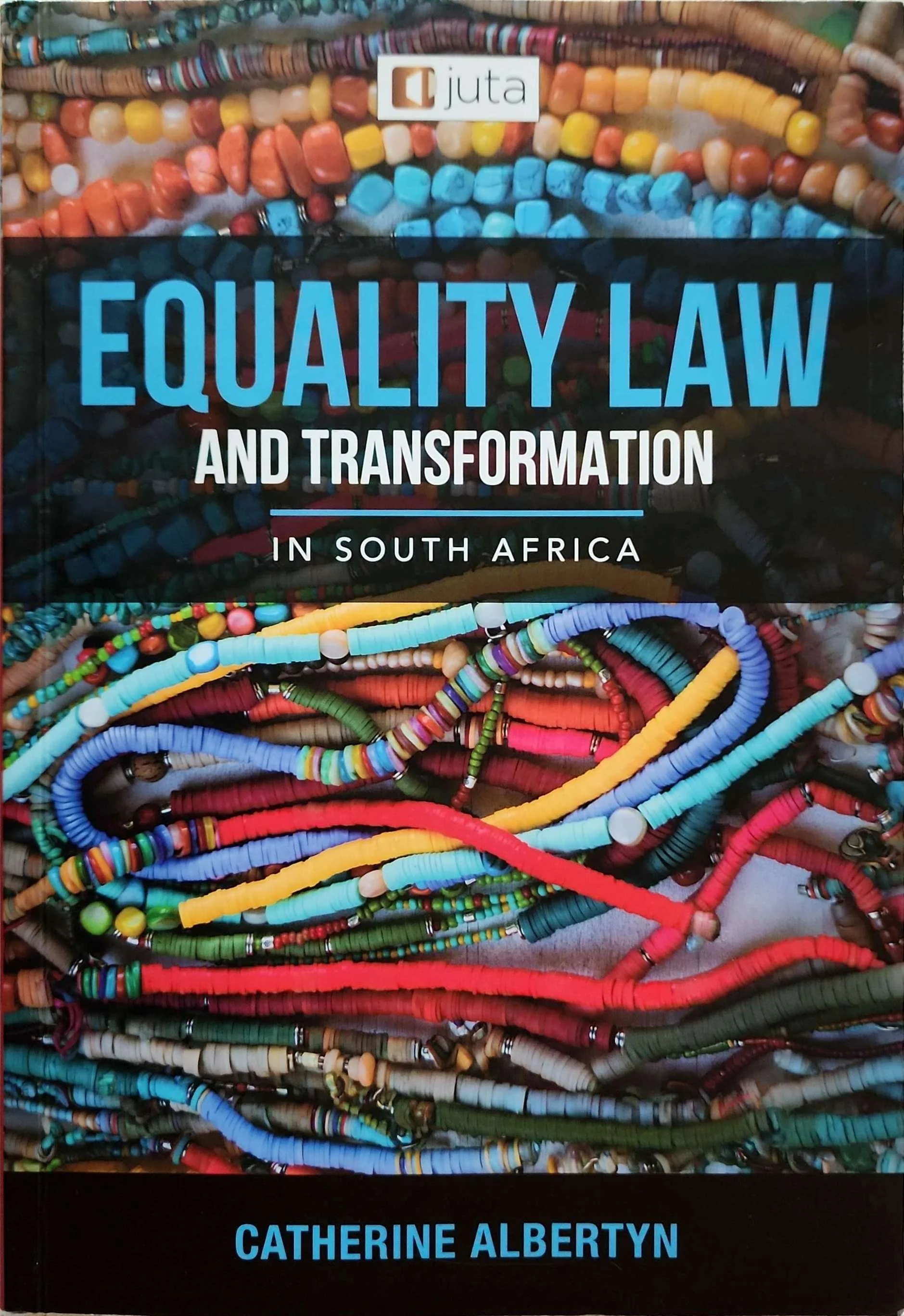
Editor’s note: This book feature highlights Professor Cathi Albertyn's recent publication, Equality Law and Transformation in South Africa. Available here.
Focusing primarily on the constitutional right to equality, the book interrogates the extent to which equality law has addressed South Africa's multiple and intersecting inequalities. Its scope is deliberately narrow, concentrating principally on the role of the courts—particularly the Constitutional Court—and its jurisprudence in advancing equality rights, rather than on the actions of the executive or Parliament or the details of public policy.
The African Law Matters team interviewed Cathi to provide readers with an overview of the book, its central arguments, and its contribution to equality law and constitutional transformation in South Africa and Africa at large.
1. Congratulations on the publication of Equality Law and Transformation in South Africa. Can you tell our ALM family what inspired you to write this book, and why you felt that now was the right time for it?
I had been active as a feminist lawyer in the 1990s, working with the women’s movement to secure equality in the South African Constitution and then policy and law. I was then based at the Centre for Applied Legal Studies at the Wits School of Law. When the Constitutional Court started its work in 1996, we also sought to influence its jurisprudence through amicus briefs and academic writing. At the heart of gender struggles and in my own work was an idea of substantive equality that was aimed at remedying disadvantage and advancing ‘transformation’. At the time, we wanted to go beyond a liberal equal rights regimes towards an idea of law that could be harnessed to dismantle structural inequalities.
The ANC government did advance women’s rights in the first Parliament; after that law reform slowed down and women turned to the courts from about 2000. For other groups, such as the National Coalition for Gay and Lesbian Equality, the courts were targeted at an early stage. Thus, from the beginning, the courts became the site of equality battles where the constitutional articulation of equality was tested. It soon became clear to me that the idea of substantive equality that was emerging from the early sexual orientation cases, while powerful as a form of recognition, was not as radical as we had hoped. And then we lost two early gender equality cases – on sex work (S v Jordan) and heterosexual cohabitees (Volks v Robinson NO). It was only when women started winning in the Constitutional Court that the jurisprudence began to advance an idea of remedying (women’s) multidimensional disadvantage. Within ten years, it was clear to me that there was a story to tell about the theory and practice of constitutional equality in South Africa, and its engagement by different groups.
The book, started more than a decade ago, explores substantive equality in South Africa. What was the history of the idea of equality in South Africa? What theories of equality existed and what was the nature of the contestation around substantive equality? What should a legal idea of substantive equality look like? Would it work in practice and what were the pathways towards more transformative outcomes? It was a long journey and I was delighted to finish writing it last year and to launch it this year.
2. More than three decades into constitutional democracy, what do you regard as South Africa's greatest achievements in advancing equality, and where do you believe the most significant challenges remain?
The central theme of the book is the extent to which the Constitution’s multi-tiered section 9 right has enabled, mandated or prevented the advancement of equality. Within that context, section 9(3) has played a fundamental role in extending recognition and relationship rights to LGB individuals and couples, arguably setting new public norms for greater recognition and paving the way for new struggles for all groups within the LGBTIQ+ community. I talk about that in the book. In addition, the Constitutional Court has extended important rights to women across customary, religious and civil marriage – especially around the distribution of property at the end of marriage through death or divorce. On the other hand, the great disappointment of Volks v Robinson NO on women in cohabiting couples took twenty years to correct (Bwanya v Master of the High Court), and the plight of sex worker remains in limbo with a stalled Bill (Criminal Law (Sexual Offences and Related Matters) Amendment Bill of 2022) and a new case commencing in the Cape High Court (SH v Minister for Justice).
The record for non-citizens is a chequered one. Despite the constitutional embrace of permanent residents and – to a lesser extent – refugees, the exclusion of people who are neither citizens nor permanent residents from registering as legal practitioners in Rafoneke v Minister of Justice was a shock to many. That case joins Volks and Jordan as a sobering reminder of the Court’s ability to retreat to formalism when confronted with ‘difficult’ cases.
If I were to pick one challenge, it would be the role of equality law in addressing economic inequality. Of course, the multidimensional nature of inequality means that many cases touch on economic issues: for example, the gendered nature for economic inequality in the family. However, more can be done to address poverty and economic inequality directly, as discussed further below.
3. The book engages with a broad range of Constitutional Court jurisprudence. Were there any judgments that you found particularly influential—or perhaps disappointing—in shaping South Africa's equality framework?
Two judgments are particularly important on the method of equality law, providing crucial precedent on the tests for evaluating equality violations. First, Harksen v Lane is fundamental to establishing the test for unfair discrimination. Beth Goldblatt and I criticised it at the time, as prioritising dignity over disadvantage, but subsequent cases have shown that it can be substantively interpreted and applied to advance a intersectional and multidimensional idea of substantive equality. I try to illustrate this in the book. Second, Van Heerden remains the gold standard on evaluating positive measures, even though the courts have retreated somewhat from its more substantive, value-based engagement.
When we consider the extent to which equality jurisprudence has protected certain groups, the body of sexual orientation cases, despite my criticisms of it, must stand as a model to other countries on how to recognise the LGBTIQ+ community. These cases also provide an exemplar of inclusive substantive equality jurisprudence. On the other hand, the gender cases are both the most disappointing (Jordan and Volks) and the most transformative in their jurisprudence. Thus we see examples of multidimensional discrimination (Daniels v Campbell); the role of intersectionality as a constitutional method (Mahlangu v Minister of Labour); a willingness to traverse previously sacrosanct domains in the private sphere (freedom of testation in King NO v De Jager); and the use of expert evidence to illustrate women’s economic precarity in marriage and to assert the economic value of care, thus grounding a finding of indirect gender discrimination in KG v Minister v Home Affairs.
Finally, Social Justice Coalition v Minister of Police, although adjudicated under the Promotion of Equality and Prevention of Unfair Discrimination Act rather than the Constitution, is both a positive example of indirect discrimination on the intersecting grounds of poverty and race and a telling example of how jurisprudential victories do not always find practical effects. In this case, the court has not yet reached the final remedial stages of the matter.
4. What is one misconception about equality law that you hope readers will reconsider after reading your book?
This is perhaps not a misconception, per se, but we often talk about formal versus substantive equality as if their meaning and interpretation are monolithic and settled. Yet they are complex concepts – both theoretically and methodologically – and they overlap and combine in multiple ways. By developing three ideas of equality and applying them to the South African jurisprudence, I hope that those who are thinking about using equality law to advance transformative objectives can see what might be needed to do so (legally and factually), where it might be immediately possible to advocate or litigate for such outcomes, and/or where progress might need to be more incremental in developing litigation or advocacy strategies to push the jurisprudence and its remedies in transformative directions.
5. Looking ahead, what developments in equality law do you think deserve greater scholarly and judicial attention over the next decade?
I do think that many of the transformative building blocks are now in place, in our academic literature if not always in court judgments: the need for a deep contextual and intersectional analysis, the role of values, the multidimensional nature of equality (beyond equal concern and respect), and so on. However, transformative judgments are relatively rare. So, we need to do the hard work to move from theory and aspiration to effective advocacy and litigation and then document and publicise successful cases. Positive and negative examples need to be widely shared and, in doing so, it is important to build an African jurisprudence: one that is rooted in the global south and on our continent.
It is also important to continue to debate the role and purpose of equality law in addressing multidimensional inequalities. We need to interrogate its role in the private sphere and in dismantling the public/private divide in much more detail (we have largely focused on the state rather than private individuals). And we need to reflect carefully on its role in addressing poverty and inequality. Important here is the role of equality law (alongside or in place of socio-economic rights) in fostering a more equal distribution of goods and services. In chapter 13 of the book, I explore the possibilities of section 9 and economic inequality; there is more work to be done!
6. Here at African Law Matters, we seek to highlight legal developments from across the continent, and South Africa forms an important part of that broader African legal landscape. In your book, you discuss the need for an indigenous understanding of equality, one that is rooted in the South African context and resonates with its people.
The question then becomes in your view, what role can African scholars, courts and legal institutions play in shaping a distinctly African understanding of equality that responds to the continent's unique histories and contemporary challenges?
The starting place is to give meaningful content to both the constitutional value and the constitutional right to equality in our particular national and regional contexts. Constitutional values speak to the vision of a better society; so what do we really mean when we talk about a society based on equality? The value is wider than the right, and we can be expansive in that vision. I argue for something more than a liberal commitment to equal concern and respect, to focus on the multidimensional inequalities experienced in the Global South. This should be a conversation amongst scholars, lawyers and judges, but also amongst civil society, seeking accountability for the achievement of equality by the state. The idea of equality is likely to be contested – we will not agree. But in that disagreement, there should be space to move forward and to provide the detail of what is needed to achieve substantive equality for everyone.
The equality right is only one way of advancing equality; it is an important pathway, but not the only one. At the risk of over-simplifying its role, the equality right is there to address and remedy relative disadvantage and inequality between different groups. Each country would need to develop its litigation strategy and jurisprudence, based on its history. Drawing on the South African and comparative experience, one of the challenges in equality jurisprudence is overcoming the reproduction of conservative, dominant norms, whether on sexual orientation, gender or citizenship and relating to ideas of family, marriage, good/bad women, nationhood, belonging and so on. The key challenge is to dismantle such norms and reconstruct more ‘egalitarian’ ones. In doing so, it would be important to draw on African values - themselves contested in interpretation.
Perhaps more important, and even prior to, building a jurisprudence is the task of building a body of academic research and writing on African equality law. Here I cannot resist the temptation to make a plug for a project I am currently engaged in, with Vicky Miyandazi of the University of Nottingham and Nomfundo Ramalekana of the University of Cape Town, to develop an edited collection on African equality law writing, which we hope to publish in 2027.
7. Finally, what do you hope readers will take away from Equality Law and Transformation in South Africa?
My book explores thirty years of equality jurisprudence, against a historical and theoretical backdrop. I hope it allows readers to understand the South African experience better. But I also hope that the new, critical generation of equality scholars in Africa takes this work forward in ways that I have not necessarily imagined – both for South Africa and elsewhere on the continent.