
Language Rights, Transformation and the Constitution: What AfriForum v University of the Free State Still Teaches Us
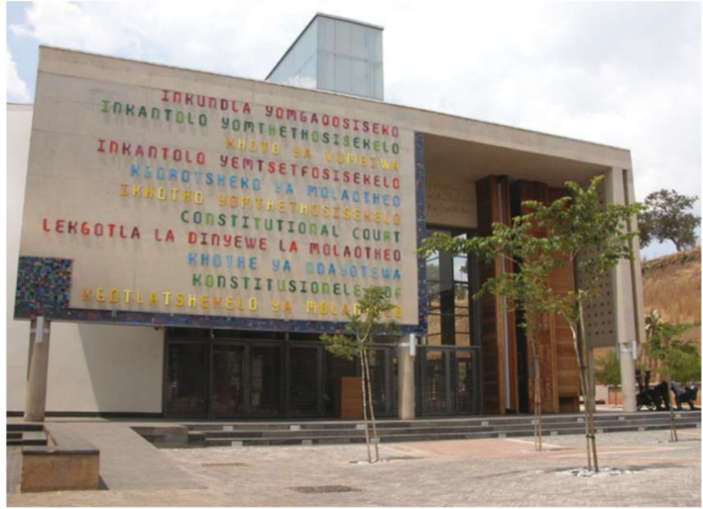
"Constitutional Court in 11 of the 12 official languages of South Africa using the Font of a Nation. Picture credit Fani Miya
Editor’s note: This blog post is an abridged version of Laubscher, Roxan’s article published in Constitutional Court Review XV.
Language has always occupied a powerful and contested space in South Africa’s constitutional project. More than a tool of communication, language is deeply tied to identity, belonging, access, and power.
Three decades into constitutional democracy, questions about how language rights should be realised, particularly in education, remain as urgent as ever. Few cases illustrate this tension as clearly as AfriForum v University of the Free State, a decision that continues to shape how courts, universities and policymakers understand language rights in a transforming society.
At the heart of the dispute in AfriForum was the University of the Free State’s decision to abandon its dual-medium Afrikaans–English language policy in favour of an English-dominant model. The university argued that the continued use of Afrikaans as a primary language of instruction entrenched racial segregation and exclusion, undermining transformation and meaningful access to higher education. AfriForum and Solidarity, representing Afrikaans-speaking students, challenged this shift as a violation of section 29(2) of the Constitution, the right to receive education in the official language or languages of one’s choice, where reasonably practicable.
The Constitutional Court’s majority judgment upheld the university’s policy. Crucially, the Court rejected the idea that section 29(2) guarantees an unqualified right to education in a preferred language. Instead, it interpreted the phrase “where reasonably practicable” as requiring a contextual, purposive assessment that balances language preferences against broader constitutional imperatives such as equality, non-racialism and access to education. In this case, the Court accepted the university’s evidence that dual-medium instruction had produced racially divided classrooms and reinforced patterns of exclusion. Maintaining Afrikaans as a parallel medium, the Court reasoned, would perpetuate inequality rather than advance linguistic diversity.
This judgment marked an important doctrinal shift. Language rights, the Court made clear, cannot be understood in isolation from South Africa’s history or its transformative constitutional goals. While language forms part of dignity and cultural identity, it may not be used, even unintentionally, to reproduce structural privilege or segregation. Froneman J’s dissent, however, offered a powerful cautionary note. He warned that the erosion of Afrikaans at public institutions risked narrowing South Africa’s already fragile commitment to multilingualism and could lead to the dominance of English at the expense of linguistic diversity. His judgment highlights an enduring concern: that transformation, if poorly implemented, may collapse into homogenisation.
“Transformation should not mean linguistic narrowing, but linguistic expansion, widening access while affirming diversity”.
Subsequent Constitutional Court decisions have largely followed the AfriForum approach. In Gelyke Kanse v University of Stellenbosch and Chairperson of the Council of UNISA v AfriForum, the Court reaffirmed that language policies must be assessed against their real-world effects on access, equality and institutional culture. Universities, as organs of state, are required to show that they have properly considered reasonably practicable alternatives before limiting language options. Once again, the Court prioritised substantive equality over formal linguistic claims, emphasising that language policies should promote inclusion rather than preserve historically exclusive environments.
What is striking across this jurisprudence, however, is the Court’s relative silence on the broader legislative framework governing language use. The Use of Official Languages Act was enacted to give effect to section 6 of the Constitution and to promote equitable use of South Africa’s official languages in public institutions. Yet the Court has not meaningfully engaged with how this Act should inform the interpretation of language rights in education, nor how it intersects with section 29(2). This omission matters. Without clear judicial guidance, language rights risk being interpreted narrowly, with courts focusing almost exclusively on transformation in higher education while neglecting the state’s parallel obligation to actively advance historically marginalised languages.
The recent constitutional recognition of South African Sign Language (SASL) as the twelfth official language further complicates this picture. On one level, the amendment represents a powerful symbolic and substantive step toward inclusion, acknowledging the linguistic rights of the Deaf community long ignored by the state. On another level, it exposes the fragility of South Africa’s language framework. Recognition alone does not guarantee implementation. Without coherent alignment between constitutional commitments, legislation, institutional policies and judicial interpretation, SASL risks becoming yet another officially recognised language that exists largely on paper.
These developments raise an uncomfortable question: has South Africa’s language rights project become fragmented? The Constitution promises parity of esteem among official languages. Legislation seeks to institutionalise multilingualism. Courts emphasise transformation and equality. Yet in practice, English continues to dominate public life, higher education, and administration, while indigenous languages remain underdeveloped and underused. Afrikaans, once a language of state power, now occupies an ambiguous position, protected in principle, but increasingly marginalised in practice.
A more integrated approach is urgently needed. Courts should engage more directly with the statutory framework when assessing language policies, rather than treating section 29(2) in isolation. Universities, in turn, must move beyond a binary choice between Afrikaans and English and take seriously their obligation to develop African languages as languages of teaching, learning, and research. Transformation should not mean linguistic narrowing, but linguistic expansion, widening access while affirming diversity.
Ultimately, language rights in South Africa are not a zero-sum game. The challenge is not to choose between equality and language, or between transformation and diversity, but to recognise that these values are constitutionally intertwined. Thirty years into democracy, AfriForum v University of the Free State reminds us that language policy is never neutral. It shapes who belongs, who succeeds, and who is heard. If South Africa is serious about its constitutional commitment to multilingualism, the next chapter of language rights must move beyond symbolic recognition and towards genuine, practical inclusion.