
Why African human rights law must not view neurodivergent people solely through the lens of disability
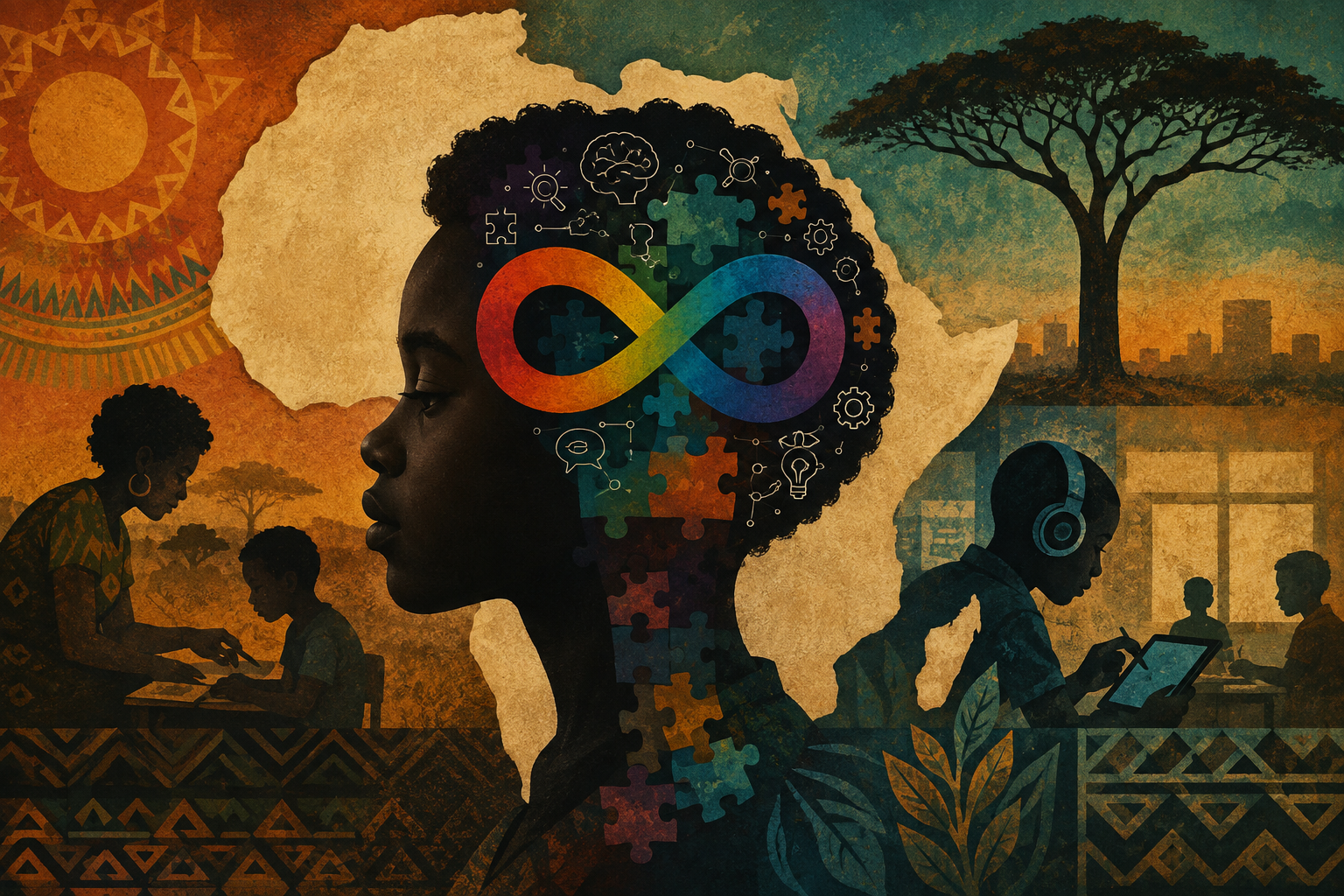
Picture Credit : AI-generated illustration created using ChatGPT (OpenAI), 2026.
Editor’s Note: This blog post is part of the Many Faces of Inequality series, featuring selected papers presented at SAIFAC's ‘Many Faces of Inequality’ Colloquium (4–5 August 2026).
African equality law has steadily expanded to recognize previously overlooked forms of discrimination. Yet one group remains largely invisible within its jurisprudence: neurodivergent people.
Autism, ADHD, dyslexia, and dyspraxia are not novel phenomena. What is relatively new is the growing recognition that these forms of cognitive difference warrant an analytical frame distinct from the one long applied to disability. Across the African continent, that conversation has scarcely begun. The African Charter on Human and Peoples’ Rights has never been called upon, in any sustained way, to engage with cognitive difference. This piece, however, argues that the interpretive resources to do so already exist within its architecture.
An old instrument, a familiar silence
The African Charter was adopted in 1981. Its equality provision, article 2, prohibits discrimination on an enumerated list of grounds before concluding with the deliberately open phrase “other status.” Its sole disability provision, article 18(4), promises “special measures of protection” for the aged and the disabled. Neither of these provisions acknowledge that some forms of exclusion have little to do with wheelchairs or ramps, and a great deal to do with sensory environments, communication norms, and unspoken assumptions about what a “normal” mind looks like. Nonetheless, the system has shown itself capable of growth as the Commission and courts have used “other status” to bring sexual orientation, albinism, and HIV status within the Charter’s protection. The case of Zimbabwe Human Rights NGO Forum v Zimbabwe is one example where the Commission described article 2 as protecting against discrimination on grounds including disability, age, and sexual orientation. There is no principled reason why the same extension should not be afforded to neurodivergent individuals.
What APDF and IHRDA v Mali teaches
In 2018, the African Court delivered its first judgment addressing women and children’s rights, striking down provisions of Mali’s family code permitting child marriage. Mali argued that widespread domestic protest had made reform politically untenable and effectively requested the court to excuse continuing harm because reversing the course would be socially disruptive. The court rejected the argument. It looked past those arguments to the girls’ structural vulnerability and held the State to its obligations regardless.
“The tools already exist. What is missing is the willingness to apply them”.
The court’s reasoning demonstrates a willingness to question not merely whether a rule is neutral on its face, but who it harms, and how much power that group has to secure its own redress. Neurodivergent people, like the girls in the Mali litigation, are rarely well positioned to compel legislative reform through ordinary political channels. Their exclusion is sustained less by any single discriminatory law than by an accumulation of small, unexamined institutional habits such as a curriculum, classroom layouts and interview formats. The Mali judgement provides a useful framework for taking that kind of diffuse disadvantage seriously.
What “Educability” conceals
South Africa’s Western Cape Forum for Intellectual Disability case is particularly instructive. The litigation exposed a two-tier system where milder intellectual disabilities were absorbed into state special schools, while severe and profound disabilities were directed to under-resourced NGO-run centres, funded at a fraction of the state’s per-child spend elsewhere. Some children received no education at all. The High Court found this to be a violation of the rights to education, dignity, and equality. In addition, the system rested on an unstated assumption about who could be considered “educable,” derived not from evidence but convention.
If one substitutes “severe intellectual disability” for “autistic,” “ADHD,” or “non-speaking,” the pattern will be recognisable to many neurodivergent people and their families. Education systems continue to sort children by their capacity to perform neurotypical behaviour which includes sitting still, sustaining eye contact, completing a timed assessment in silence, while discriminating against neurodiverse children who do not conform to such behaviour. The Western Cape Forum judgement demonstrates that courts can see through such institutional conventions. Moreover, it highlights, in its limits, that a merely “reasonable” state response is insufficient. A shortcoming which later commentary has argued left the judgment short of a fully substantive equality analysis. Segregation presented as accommodation remains segregation.
Why neurodivergence cannot simply be absorbed into disability law
It would be tempting to conclude that neurodivergent people should simply be treated as disabled people and leave the matter there. Many are, in fact, disabled, and instruments such as the African Union’s 2018 Disability Protocol, in force since 2024, remain indispensable. However, disability law was built principally around visible, stable, medically documentable impairment for example, ramps for wheelchair users, and interpreters for deaf people. Neurodivergent exclusion is frequently invisible, inconsistent across contexts, and rooted in communication style rather than physical access. This framework does not, without adaptation, know what to make of a sensory-overwhelming workplace, or an interview that penalises atypical eye contact.
The neurodiversity paradigm holds that cognitive difference is not a deficit requiring correction, but a form of human variation that becomes disabling largely through environmental design. A framework that imports a “corrective” logic works against that premise. An African framework must also resist importing ideas developed mostly in wealthy, Global North settings. An example would include formal diagnosis which remains scarce and costly across the continent, and protection cannot depend on ever seeing a specialist.
Towards a framework
None of this requires amending the Charter, only applying it properly. A workable framework would anchor neurodivergence within Article 2's "other status" category, following the path already used for sexual orientation and albinism, while preserving Article 18(4) and the Disability Protocol for those who are also disabled. A vulnerability-sensitive standard of review method would apply. This method is drawn from the Mali case, that looks beyond whether a policy is prima facie neutral. It would investigate who is really disadvantaged, and how much power this disadvantaged group of people have, to challenge it themselves. Once a policy is shown to disproportionately exclude neurodivergent people, the state should be required to justify it against a meaningful standard of equality, rather than merely demonstrating it is not irrational. This approach would require decisions to be based on evidence rather than assumption, which will include comparing actual resource allocation, as was in the case of Western Cape Forum. Remedies would have to be designed that promote dignity rather than those that conform to conventional notions of “normality”.
An existing right, properly read
Nothing in this argument requires African states to conclude a new treaty or fashion a new right from nothing. It requires the African human rights system to do what it has done before and that is to read its own equality guarantee considering those who are being excluded. Neurodivergent people across the continent remain largely invisible to that guarantee. The reason is not because the Charter cannot recognise them, but because no person or institution to date has requested a closer examination of the framework. The tools already exist. What is missing is the willingness to apply them.
As conversations about equality continue to evolve across Africa, recognising neurodivergence as an equality issue, rather than solely a disability issue, offers an opportunity to deepen the African human rights system's commitment to substantive equality and ensure that the Charter's promise of equality extends to those whose exclusion has too often gone unseen